neurolinguists toolbox

A Neuro-Linguist's Toolbox - Self-Care and Improvement: Preliminary Thoughts

On 12 September 2019, our Training Director, Professor Joel Lee, published a blog post on the Kluwer Mediation Blog entitled "A Neuro-Linguist's Toolbox - Self-Care and Improvement: Preliminary Thoughts". His blog post is reproduced in full below.


A Brief Recap

I have been looking into matters of self-care and personal improvement for mediators recently and was surprised to find that, even though there has been some writing on this, there isnโ€™t a lot. So, I would like to focus my next section of blog entries in the โ€œNeuro-Linguistโ€™s Toolboxโ€ series.

For readers who are new, the โ€œNeuro-Linguistโ€™s Toolboxโ€ series is an ongoing series focused on using Neuro-Linguistic Programming (NLP) in our practice of amicable dispute resolution. The first section (with 6 entries) focused on rapport

1. A Neuro-Linguistโ€™s Toolbox โ€“ A Starting Point and Building Rapport
2. A Neuro-Linguistโ€™s Toolbox โ€“ Rapport: Non-Verbal Behaviours
3. A Neuro-Linguistโ€™s Toolbox โ€“ Rapport: Representational Systems (Part 1)
4. A Neuro-Linguistโ€™s Toolbox โ€“ Rapport: Representational Systems (Part 2)
5. A Neuro-Linguistโ€™s Toolbox โ€“ Rapport: Values
6. A Neuro-Linguistโ€™s Toolbox โ€“ Rapport: Metaphors

Now that the preliminaries are out of the way, onward to self-care and improvement. It is trite, or at least it should be, that as mediators, self-care and improvement should be an important part of our practice. I say this for three reasons.

Self-Care and Improvement

First, as mediators, we are constantly exposed to conflict and have to deal with strong emotions and high levels of stress, not just the parties but our own. This is in addition to whatever conflicts, emotions and stresses that we have to deal with in the other contexts of our own lives. And while some of us can dissociate and keep the contexts separate, the reality of it is that these build up and leak between contexts.

How many of you feel exhausted at the end of a particularly intense mediation? In the medical community, there is the anecdotal phenomena of some nurses and doctors manifesting the symptoms of their patients. There are similar reports in therapy and counselling and this is often associated with burnout and PTSD. If this is accurate, then there is every reason to expect that the conflicts, emotions and stresses associated with our mediation work can leak into and shade the other contexts of our lives.

Secondly, as mediators, we are often unconscious behavioural models for parties. How we approach conflict, manage emotions and deal with stresses can significantly influence how parties behave in a mediation. So, it is important that we be in the best state we can be in when starting a mediation and maintain the best ongoing state as the mediation progresses.

Finally, as a matter of practice, it is often good to reflect upon what we did well during the course of the mediation and what did not go as gloriously. The key, of course, is to positively reinforce the things we did well and to identify what could have been done differently, with a view to improvement. Life of course, is not always this easy.

Sometimes, what gets in the way of good reflective practice are our personal demons, insecurities and emotions. As a result of some bad experiences, some mediators experience identity quakes about their abilities to mediate well. Others may feel strong negative emotions in dealing with conflict or certain types of parties. These will impair our performance and our ability to learn and develop.

Some Reflections

There is an internet meme (I know others disagree but I feel there is a lot of wisdom on the internet!)
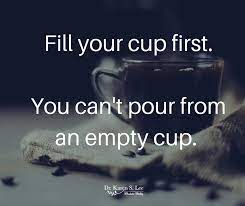
As people helpers, if we do not find some way to take care of ourselves, we are no good to the people we are supposed to help.

I remember a visit to the Samadhan Mediation Centre when I was in New Delhi for a conference on mediation. As we were shown around the facilities, we came across a room, curiously labeled โ€œMeditation Roomโ€. Initially I thought it was a misspelling of โ€œMediation Roomโ€. However, upon clarification, we were told that the room was for the Samadhan Mediation Centreโ€™s mediators to meditate; before and/or after their mediation session.

While meditation does take on connotations of mental voyages and in some cultures mysticism, if we look at this simply as spending time alone, and sorting out and coming to terms with oneโ€™s own thoughts and emotions, then the self-care and improvement aspect is evident. In a sense, meditation is self-mediation.

The Non-NLP ways of Self-Care

Letโ€™s get out of the way the things that we can and should do by way of self-care that is not NLP related.

1. Get sufficient sleep
2. Exercise regularly
3. Attend to your food needs
4. Make time for yourself

And these things in and of themselves can already take you a long way. And if you were to search on the internet, there will be sites that list many more things that you can do to look after yourself. I have simply identified these four as fundamental.

Why NLP then?

NLP started off when its co-founders John Grinder and Richard Bandler modelled Virginia Satir (Systemic Family Therapist), Fritz Perls (Gestalt Therapy) and Milton Erickson (Clinical Hypnotherapy) and distilled the patterns of behaviour that allowed them to perform the therapeutic โ€œmiraclesโ€ they did. So in a sense, NLP had its beginnings in the helping professions and even today, NLP provides some of the more powerful methods of engendering personal development and change.

As a primer for the next entries to follow, I would like to briefly share with readers how NLP sees the interplay between Physiology, State and Representation.

Physiology

Physiology is fairly straightforward. It refers to our body; how we sit, stand, move, etc.

State

State refers to how we feel at any moment. These are the sensations we feel inside us; location, temperature, movement, etc. While it might be tempting to call these emotions, they are not necessarily the same thing. Emotions are the linguistic labels we have attached to the sensations we feel. Imagine as a child, you might have a sensation in your stomach region that feels tight, knotted and stuck. As a child, you would only know the sensation. You would have no words to describe it and would not know it as an emotion. You simply feel the sensation and it would manifest in your behaviours. Then an adult comes by, observes your behaviour and says โ€œYouโ€™re feeling frustration!โ€. Now you have a word to describe how you feel. But it is important to realise that the emotional label is not the sensations that make up the state.

Representations

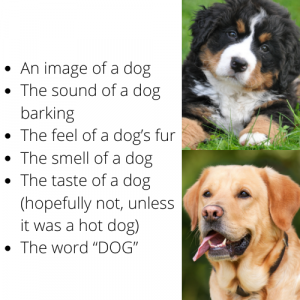
Representations refers to the way we represent the world inside our heads. Try this thought experiment. In a moment, not yet, I would like you to think of a โ€œdogโ€. 

In order for you to do that, you probably had in your mind:

VisualAn image of a dog
AuditoryThe sound of a dog barking
KinestheticThe feel of a dogโ€™s fur
OlfactoryThe smell of a dog
GustatoryThe taste of a dog [hopefully not, unless it was a hot dog]
DigitalThe word โ€œDOGโ€

You might have had only one of these or a combination of more than one. In NLP terms, we represent the world to ourselves in one of these six ways. The first 5 relate to the senses of sight, hearing, touch, smell and taste. The sixth way of representing the world is more meta, more digital and is more a label without connection to any particular sense. The word โ€œDOGโ€ has nothing to do with any of the senses. It is simply a label in much the same way that an โ€œemotionโ€ is simply a label for the sensations we feel.

In Closing

From NLPโ€™s perspective, Physiology, State and Representation interact systemically. Put another way, when we experience something, our physiology, representation and state have to form a certain configuration. NLP posits that by changing one of these aspects of the configuration, we can change the experience. The easiest of these 3 aspects to change is actually physiology and we will explore how to do this in future entries. For the moment, a humourous illustration of this isย Charlie Brownโ€™s depressed stance.

This is not to say that we cannot alter our state or representations and this will also be something to explore in future entries.

I trust this gives us a good starting point to considering self-care and improvement in future entries. In the meantime, take care of yourself so you can take care of others!


To learn more about how Neuro-Linguistic Programming can help you, join us on the journey towards solving "The People Puzzle" - Prof Joel's flagship NLP training series. Obtain the blueprint to achieve greater self-awareness, enhance communication with others, and connect with people more effectively.

Unlock the People Puzzle today! 👉 https://peacemakers.sg/the-people-puzzle/
neurolinguists toolbox

A Neuro-Linguist's Toolbox - Rapport: Metaphors

On 12 January 2019, our Training Director, Professor Joel Lee, published a blog post on the Kluwer Mediation Blog entitled "A Neuro-Linguist's Toolbox - Rapport: Metaphors". His blog post is reproduced in full below.


A Brief Recap

This entry is an ongoing series focused on using Neuro-Linguistic Programming in our practice of amicable dispute resolution. For ease of reference and the convenience of readers, I will list in this and subsequent entries the series and links to it.

1. A Neuro-Linguistโ€™s Toolbox โ€“ A Starting Point and Building Rapport
2. A Neuro-Linguistโ€™s Toolbox โ€“ Rapport: Non-Verbal Behaviours
3. A Neuro-Linguistโ€™s Toolbox โ€“ Rapport: Representational Systems (Part 1)
4. A Neuro-Linguistโ€™s Toolbox โ€“ Rapport: Representational Systems (Part 2)
5. A Neuro-Linguistโ€™s Toolbox โ€“ Rapport: Values

In the previous instalments in this series, we explored building rapport by pacing non-verbal behaviours, representational systems and values. In the sixth of this series, I would like to focus on pacing something as deep as, if not deeper than, values; metaphors.

Metaphors

The followers of this series who have read parts 3 & 4 will remember that visual, auditory or kinesthetic predicates are often taken to be metaphorical expressions when in fact, they function quite literally. When someone says โ€œI see what you are sayingโ€, they are actually looking at an internal image/movie that represents what they have constructed from what you have said. The same is true in the auditory or kinesthetic representational systems when they say โ€œThat sounds sensibleโ€ or โ€œThat feels rightโ€ respectively.

That these (often assumed to be) metaphorical expressions are literal does not mean that our brains are literal. The thinking in cognitive psychology, narrative theory and neuroscience suggest that the human brains function associatively. Put simply, things, ideas and concepts are connected to and associated with other things, ideas and concepts.

How Connections Occur

These connections occur in one of two ways. The first is a cause and effect, i.e. X leads to Y. For example, someone might say โ€œExercising makes me strongโ€. This connection is quite straightforward and will probably have few people disagree with them. However, a cause and effect statement like โ€œBeing a man makes me an angry and aggressive personโ€ is probably a connection that will take a few more mental leaps for others to get. And even when they do get it, they may not agree. The point however is that this cause and effect connection is very real for the person making the statement. In other words, it is a belief.

Perhaps we will discuss beliefs in a subsequent instalment in this series. For this instalment, I would like to focus on the second connection. This is the equating of 2 things, ideas or concepts with another, i.e. X = Y. In NLP, this is referred to as a complex equivalent. For example, โ€œMy love is like a house on fireโ€ or โ€œLife is an uphill battleโ€ or โ€œIn business, itโ€™s a jungle out thereโ€. In each of these examples, you will see that two things are equated; โ€œLoveโ€ with โ€œHouse on Fireโ€, โ€œLifeโ€ with โ€œUphill Battle", and the โ€œBusinessโ€ context with โ€œJungleโ€. These are also all beliefs but expressed metaphorically.

At this point, it is useful to point out that while in language, there are technical differences between analogies, similes and metaphors, it is sufficient for our purpose to take a metaphor to be any equivalence between two things, ideas or concepts.

Let's play!

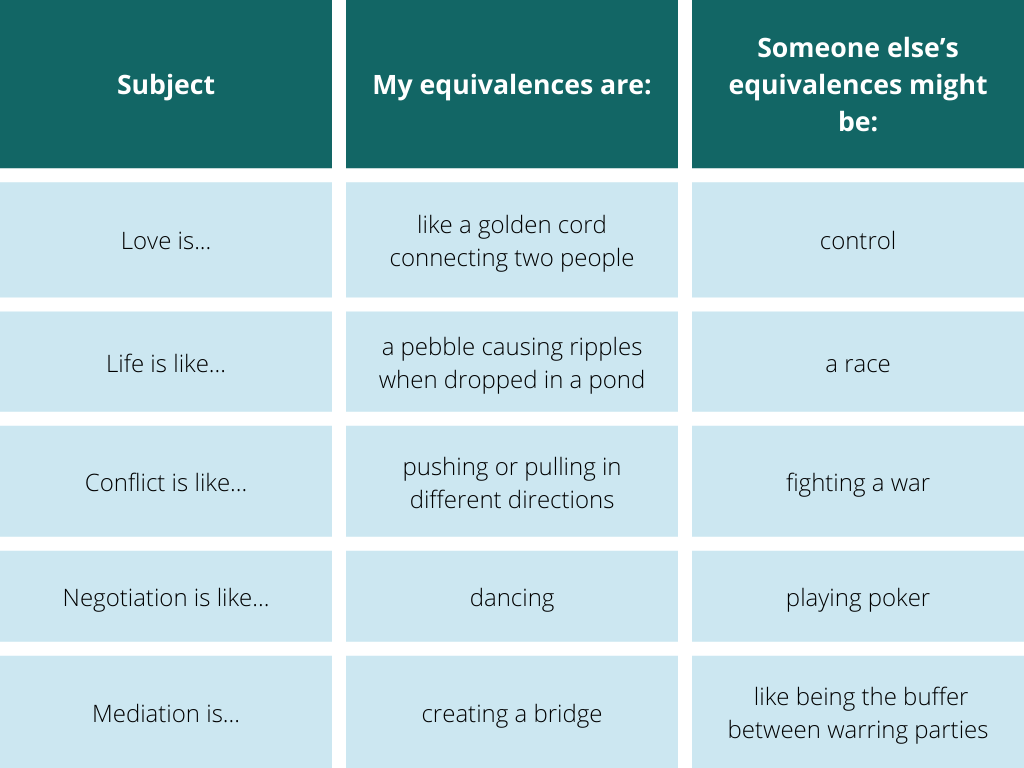
Take the time to complete the following equivalences (If it is easier, one can exclude the word โ€œlikeโ€):

Love is likeโ€ฆ

Life is likeโ€ฆ

Conflict is likeโ€ฆ

Negotiation is likeโ€ฆ

Mediation is likeโ€ฆ

Take a moment to compare your list of equivalences with mine and then with the third list. Are there any that are the same? Or, while not exactly the same, have a similar intent or spirit? Perhaps diametrically opposed?

What do our Metaphors mean?

These equivalences or metaphors are how we perceive and interact with the world.

For each metaphor, there are values and beliefs associated with that metaphor. Someone who sees conflict as fighting a war may believe that in a conflict, there must be a winner or a loser. That there will be casualties or collateral damage and that having superior fire power will determine the outcome.

This person will see the world very differently from the person who sees conflict as growth who does not necessarily think that there is a winner or loser. S/he may consider that conflict means helping each other learn.

And of course, these metaphors affect our behaviours as we interact with the world.

Therefore, learning to identify the metaphors people hold in various contexts can give us significant insight into their mindset and their behaviours. And this can be done conversationally by simply asking them in relation to any particular thing โ€œWhatโ€™s that like for you?โ€ So, if we were talking about conflict, you could ask me, โ€œWhatโ€™s conflict like for you?โ€

Building Rapport

Sometimes, the metaphor will just pop straight out. Other times, it may be โ€œhiddenโ€ within various things they say. This is when listening skills come in very useful. Metaphors surface in the things people say. For example, โ€œWe need to strengthen our defensesโ€ or โ€œWe are fighting a war against ignoranceโ€. If these are statements that stem from a particular metaphorical view of the world, what would that metaphor be? For example, โ€œstrengthening defensesโ€ could come from a metaphor of war or battle. It could invoke feelings of being under siege or losing ground. And the metaphor itself implies that they see that particular context as a win-lose situation.

Once we can hear and identify these metaphors, the issue isnโ€™t whether we agree with them or see them the same way. We can use them to build rapport by pacing their reality. This can be done by using the same terms, or speaking to their values or beliefs. For example, with someone who sees conflict as a battle, we can use metaphors of war to connect with them. This will build rapport with them at a fairly deep level.

How do we practice this?

At this point, it is important to point out that because metaphors shade into the content of what we do, it may not always be helpful to only pace their metaphorical world view. Doing this will only tap into a metaphor that may not be conducive to our purposes. For example, if we were negotiating a dispute and our counterpart saw negotiation as a battle, buying into that win-lose paradigm would not be helpful, especially if your metaphor is an incompatible one.

The key thing to remember is that for the purposes of building rapport, we must first pace their model of the world and understand their reality. Once we have rapport, we can then lead them in a more useful or conducive direction. In terms of metaphor work, this could mean reframing their metaphor or utilizing it or evolving it. Discussing these interventions is outside the scope of this entry and may be the subject of a future instalment in this series.

That brings us to the end of this entry and also concludes the section on building rapport. It is hoped that this section has provided readers with more tools in their toolbox (you should be noticing the metaphor here) to connect with others in the contexts you operate within and that readers have found these tools helpful and empowering.


To learn more about how Neuro-Linguistic Programming can help you, join us on the journey towards solving "The People Puzzle" - Prof Joel's flagship NLP training series. Obtain the blueprint to achieve greater self-awareness, enhance communication with others, and connect with people more effectively.

Unlock the People Puzzle today! 👉 https://peacemakers.sg/the-people-puzzle/
neurolinguists toolbox

A Neuro-Linguist's Toolbox - Rapport: Values

On 12 December 2018, our Training Director, Professor Joel Lee, published a blog post on the Kluwer Mediation Blog entitled "A Neuro-Linguist's Toolbox - Rapport: Values". His blog post is reproduced in full below.


A Brief Recap

This entry is an ongoing series focused on using Neuro-Linguistic Programming in our practice of amicable dispute resolution. For ease of reference and the convenience of readers, I will list in this and subsequent entries the series and links to it.

1. A Neuro-Linguistโ€™s Toolbox โ€“ A Starting Point and Building Rapport
2. A Neuro-Linguistโ€™s Toolbox โ€“ Rapport: Non-Verbal Behaviours
3. A Neuro-Linguistโ€™s Toolbox โ€“ Rapport: Representational Systems (Part 1)
4. A Neuro-Linguistโ€™s Toolbox โ€“ Rapport: Representational Systems (Part 2)

In the previous instalments in this series, we explored building rapport by pacing non-verbal behaviours or representational systems. In the fifth of this series, I would like to focus on pacing something deeper than just behaviours, values.

Values

In NLP, values are things which are important to us. They are higher level generalisations that help us decide whether actions (ours or others) or a particular situation is good or bad, or right or wrong. In some NLP circles, values are also referred to as โ€œcriteriaโ€.

This is better illustrated by an example. Can you think of a time when somebody did or said something that you were affronted by or that you found offensive? As you think about that time and work through your initial emotional response to it, what was it about that personโ€™s action that caused you to be so upset? What did his/her action mean to you? Why was it important to you? Chances are that anytime that an action upsets us significantly, it is because it goes against one of our values.

What are our values?

It is not easy to identify these values because they are deeply held and often unconscious to us. They can however be elicited. For example, if I were to ask you this โ€œWhat is important to you in a relationshipโ€?

Do take a moment to fully consider this question. What word or phrases come up? What do you want? Why is what you want important? As you identify these words or phrases, you will probably come up with a list of 3-7 items. My list would be:

  • Fun
  • Touch
  • Love
  • Togetherness
  • Communication

Based on this list, I am not likely to stay in a relationship with someone that likes to spend time alone, does not like physical contact or is very serious. I will instead gravitate to someone with whom these values are met.

At this point, it is important to be clear. This is my list of values of what is important to me in a relationship. Yours will look different. It may be longer or shorter and may share common values with my list. And everyone elseโ€™s list will be unique to them.

How do we use this for Conflict Resolution?

Following the same principle of building rapport using non-verbal behaviours or representational systems, one simply paces. This can be done by feeding those values back to speaker when one summarizes or paraphrases, or by getting them to elaborate on what those values mean to them. By doing so, the listener gets a clear sense that you not only appreciate something that is core to them, but are interested in finding out more about what is important to them.

For example, someone might say โ€œThings worked well for a while and then he stopped sharing information. At that point, I wasnโ€™t sure I could trust him anymore.โ€

In this short sentence, two critical bits of information jump out. The first is that the counterpart stopped sharing information. The second was that, as a result of the counterpart stopping the sharing of information, trust was affected.

Often, when a speaker expresses a value, it is often accompanied by tonal or behavioural marking. What this means is that the speaker will manifest some kind of tonal or behavioural change while expressing that value. This could be pausing before the word, or saying it in a different volume, or manifesting a facial colour change or using gestures to emphasize that value.

How can we be sure?

Of course, right now, we are simply making an educated guess. What is important is to test the hypothesis. For example, we could paraphrase/summarise and ask them whether trust (or communication) is important to them in a working relationship. We could ask them to say more about what trust means to them and why it is important. We can even feed that particular value back to them and watch that response. Often, when you have correctly identified the value, by feeding it back to them, you will see a congruent non-verbal acknowledgement from them. And if we have correctly identified a value, doing this will itself will build rapport with that party.

I appreciate that this may sound quite complicated. The good news is that mediators already do this as part of their practice, but not in relation to values but in relation to interests. As mediators, we are trained to elicit the interests of parties by asking questions that probe for what is important behind the positions they come to the table with. And because parties arenโ€™t always explicit about their interests, we are also trained to โ€œlisten between the linesโ€ to identify what is important to them.

These same skill sets are applicable to eliciting and listening for values. And the bonus is that when eliciting for interests, values often pop out. In fact, some of the higher level interests are often expressed as values.

How do we practice this?

What follows is an activity that can help you hone your ability to elicit and listen for values.

Find a friend to practise eliciting their values with. Identify a context like relationship, family, work etc
Ask him/her โ€œWhat is important to you in a [insert the chosen context]"
Listen for his/her answers and list down the values that are expressed. Sometimes, they may be at a loss for words when asked this question. This is because they are accessing something that is so deeply unconscious that it will take them some effort to put words to what is important to them.
Using the list you have elicited, paraphrase the values to them to check if you have understood them correctly.
Then for each of the values, ask them what each value means to them and why they are important.
For fun, feed the wrong set of values back to them and notice their reaction. For example, if in the context of business, the values elicited are integrity, success, relationship and win-win, say to them โ€œSo, let me understand if Iโ€™ve got this. In business whatโ€™s important to you is short term profit, getting one up on the other person and competition. Is that right?โ€
Then, again for fun, now feed the correct set of values back to them and notice their reaction. You will notice that in this latter situation, the values will resonate with them and you may even see behavioural manifestations of rapport like a flushing of the skin or a shift in breathing.

This has, of course, been a necessarily brief tour of values within NLP with a particular focus on building rapport. Values can be utilized in other ways like persuasion or personal change which may be explored in future entries. Enjoy!


To learn more about how Neuro-Linguistic Programming can help you, join us on the journey towards solving "The People Puzzle" - Prof Joel's flagship NLP training series. Obtain the blueprint to achieve greater self-awareness, enhance communication with others, and connect with people more effectively.

Unlock the People Puzzle today! 👉 https://peacemakers.sg/the-people-puzzle/
neurolinguists toolbox

A Neuro-Linguist's Toolbox - Rapport: Representational Systems (Part 2)

On 10 June 2018, our Training Director, Professor Joel Lee, published a blog post on the Kluwer Mediation Blog entitled "A Neuro-Linguist's Toolbox - Rapport: Representational Systems (Part 2)". His blog post is reproduced in full below.


A Brief Recap

This entry is an ongoing series focused on using Neuro-Linguistic Programming in our practice of amicable dispute resolution. For ease of reference and the convenience of readers, I will list in this and subsequent entries the series and links to it.

  1. A Neuro-Linguist's Toolbox - A Starting Point and Building Rapport
  2. A Neuro-Linguist's Toolbox - Rapport: Non-Verbal Behaviours
  3. A Neuro-Linguist's Toolbox - Rapport: Representational Systems (Part 1)

In the third part of this series, we focused on how one could build rapport using representational systems by identifying the predicates that were in use by the counterpart.

In this fourth part in the series, I would like to focus on other ways one can identify the representational systems that are in use at that point in time.

We will look at each of the visual, auditory, kinesthetic and digital representation systems in turn. For each of these, we will look at four aspects (where relevant and appropriate) that will provide us clues to the representational system that is in play. These 4 aspects are posture, gestures, rate of speech and breath. One quick caveat, these 4 aspects are systemic and should not be looked at in isolation. Instead, we need to assess them wholistically.

Visual Processing

Someone who is processing visually tends to have an upright posture. They will hold their bodies straight, their heads tilted slight upwards and while they may not stand still, their bodies or feet will move very little. Sometimes it may seem as if they were looking at something in the air in front of them. And in a sense, they are looking at the pictures inside their mind space.

To emphasize this, when talking, their hand gestures often occur above chest height, sometimes head height. These gestures may be animated and seem to be pointing to or illustrating things in the air. This makes sense if they are trying to point out to you the things they are seeing inside their mind.

Because of their posture, someone processing visually will exhibit shallow breathing, usually in the top third of the chest. This is commonly detected by the marked rise and fall of the shoulders.

This will in turn affect their rate of speech. They will tend to speak quite quickly and often at a higher pitch (relative to their normal pitch register). Again, this makes sense if you imagine that they have many images or a very clear image and they are trying to put into words what they see.

Auditory Processing

Someone who is processing auditorily tends to have a relaxed posture. Not too upright nor hunched. Their heads may nod, bob or move from side to side, and their bodies may also shift from side to side almost as if they were moving to a beat inside their head, And in a sense, they are.

Their hand gestures will be at chest height or mid-torso and will generally move rhythmically and often in beat, and to emphasise the impact of what is being said.

Breathing is often at the mid-chest although this is often hard to detect. Their speech tends to be rhythmic, their pitch variable and can sometimes seem sing-song.

Kinesthetic Processing

Someone who is processing kinesthetically, tends to have a hunched posture and their heads are often angled downwards. They may also move very little, almost as if their bodies were very heavy.

Their hands gestures, if any, are often at the lower torso and are generally not animated. Again, they might move as if they were very heavy.

Someone processing kinesthetically will breathe deeply and fully. Sometimes, it may even seem as if they were sighing. This in turn affects their speech. They will speak relatively slowly and likely to be at a lower pitch (relative to their normal pitch register). It will almost be as if they were feeling and weighing everything in order to process it.

Digital Processing

Someone who is processing digitally tends to have an upright posture with a relatively unmoving body. Their head is often tilted to the side as if listening to something and they will have minimal hand gestures. However, they may cross their arms when they speak or position a hand to their chin or the side of their head, almost as if they were listening to a telephone.

Someone who is processing digitally will manifest variable rates of speech, pitch and breathing. However, their choice of words will almost always be measured and precise. These will be the wordsmiths of the world.

So these non-verbal c(l)ues provide us additional ways to identify the representational system that is currently in operation. It is important to point out that it is more art than science, although there is some science involved. As such, one should be making a judgment call taking into account the predicates and these non-verbal c(l)ues.

Identifying additional indicators of representational systems

One way would be to engage in the past time of people watching. The next time you are part of a group who are having a conversation and you donโ€™t have to speak, listen to and watch the people speaking. Identify their predicates and notice the correlation the predicates have with how they hold their body and head, how much they move, where they breathe, their rate of speech, their pitch and their hand gestures.

As you get more skillful with this, then begin to practice this when having a conversation with someone. Of course, do this in a social, low risk situation until it becomes second nature to you. Then, depending on your assessment of what representational system they are using, match their non-verbals and use predicates from that representational system and notice how it affects your rapport and communication with them. And just for fun, mismatch the non-verbals and predicates and notice how that makes a difference.

Eye-Accessing C(l)ues

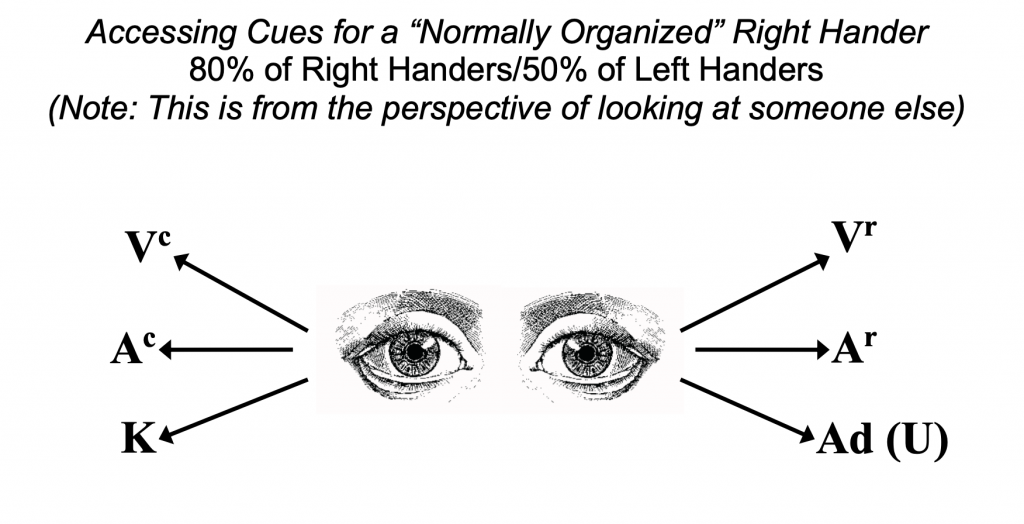
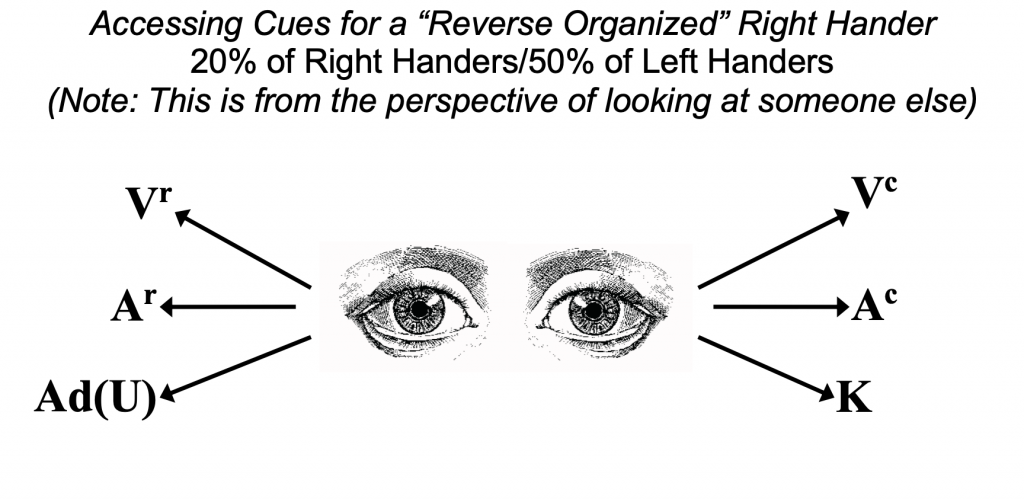
There is one additional non-verbal c(l)ue that I wanted to discuss separately and these are eye-accessing cues. The NLP model of eye-accessing cues postulates that oneโ€™s eyes will move in certain directions to access certain types of information. According to this model, when someone is accessing the visual representational system, their eyes will move up and to the right and/or left. When someone is accessing the auditory representation system, their eyes will move horizontally to the right and/or left.

Before looking at kinesthetic and digital accessing, it is useful at this point to note that the NLP eye-accessing cue model is a little more complex than what has just been represented. For example, the model makes a distinction between whether an access is remembered or constructed. So, if the personโ€™s eyes go up and to their left, for most people (80% of right handers and 50% of left handers) this means that they are accessing a remembered image. A question like โ€œWhat is the colour of your living roomโ€ might prompt that this access. If the personโ€™s eyes go up and to their right, in most people, this means they are constructing an image. A question like โ€œWhat would your living room look like painted with purple polka dots?โ€ might prompt this access.The same applies to auditory access.

Does everyone's eyes move the same way?

Whether the eyes go to their left or right determine whether it is remembered or constructed respectively for most people.

Two points can be made here. First, the reverse is true for the remainder of people (20% of right handers and the other 50% of left handers). In other words, for people who fall into this category, the eyes moving to their left indicate construct and moving to their right indicate remembered.

Secondly, it is important to note that a constructed sound or image does not mean that the person is lying. This is a fallacy that was unfortunately perpetuated by Hollywood.

From a communication perspective, this does not affect us. When we see their eyes move upwards, it is visual access and when their eyes move horizontally, it is auditory.

A Trickier Level looking Down

Having now noted this additional layer of complexity, we can look at kinesthetic and digital access. In most people, when their eyes move down and to their left, they are accessing digitally. Put another way, they are talking to themselves. A question like โ€œCan you recite your favourite nursery rhyme quietly to yourself?โ€ might prompt this access. When their eyes move down and to their right, they are kinesthetically accessing feelings or sensations. A question like โ€œHow does your right foot feel right now?โ€ might prompt this access.

Readers will quickly realise that this means that, while moving the eyes to the left and right does not matter for visual and auditory access, it does for kinesthetic and digital. Without having to go into a complex analysis on this matter, three quick solutions present itself.

First, you have the benefit of predicates and other cues to help you come to an educated guess. And this will often resolve the matter. However, on the assumption that it does not, then secondly, go with the averages. Since most people access kinesthetic when going down and to the right, communicate with them kinesthetically and calibrate to their response. If it maintains or improved rapport, then you have probably got it right. If it does not, try a digital response and see what happens.

Finally, if all else fails, go with the digital response. Readers will remember from the third post in this series that the digital system is separate from any particular representational system. The digital system is one of words which is meta to sight, sound or touch. As such, when speaking to someone using the digital system, the listener is free to access whichever representational system that they wish.

How might one practice this?

Like calibrating to the other non-verbal c(l)ues, people watch. Notice where their eyes go when they are listening or when they are being asked a question. Note where their eyes go last before they respond and identify that representational system. Correlate your observation with the predicates they use and the other non-verbal c(l)ues. Again, do this in a social and low risk situation, not in the most important life conversation at least until you gain facility with this.

This brings us to the end of building rapport using representational systems. I trust it has given you new ideas to think about and that you have found it useful.


To learn more about how Neuro-Linguistic Programming can help you, join us on the journey towards solving "The People Puzzle" - Prof Joel's flagship NLP training series. Obtain the blueprint to achieve greater self-awareness, enhance communication with others, and connect with people more effectively.

Unlock the People Puzzle today! 👉 https://peacemakers.sg/the-people-puzzle/
neurolinguists toolbox

A Neuro-Linguist's Toolbox - Rapport: Representational Systems (Part 1)

On 12 April 2018, our Training Director, Professor Joel Lee, published a blog post on the Kluwer Mediation Blog entitled "A Neuro-Linguist's Toolbox - Rapport: Representational Systems (Part 1)". His blog post is reproduced in full below.


A Brief Recap

This entry is an ongoing series focused on using Neuro-Linguistic Programming in our practice of amicable dispute resolution. For ease of reference and the convenience of readers, I will list in this and subsequent entries the series and links to it.

  1. A Neuro-Linguist's Toolbox - A Starting Point and Building Rapport
  2. A Neuro-Linguist's Toolbox - Rapport: Non-Verbal Behaviours

In this, the third in the series, I would like to focus on how one can build rapport using representational systems.

A Starting Point

Iโ€™m sure you can remember hearing people make statements like:

see what you mean
hear what you are saying
feel where you are coming from
understand what you mean

Most of the time, when we hear these statements, we chalk it up to metaphorical expressions of expressing understanding. However, NLP, takes the approach that these expressions are more than metaphorical. That they are literal descriptions of what is happening inside our heads.

It is perhaps easier to illustrate this through a thought experiment. In a moment, not yet, I would like you to think of a โ€œdogโ€.

In order for you to do that, you probably had in your mind:

You might have had only one of these or a combination of more than one. In NLP terms, we represent the world to ourselves in one of six ways.

VisualAuditoryKinestheticOlfactoryGustatoryDigitally

The Six Ways

At this point, the astute reader may notice that the first five ways of representing the world revolve around the 5 senses of sight, hearing, touch, smell and taste. The sixth way of representing the world is more meta, more digital and is more a label without connection to any particular sense. For example, the word โ€œDOGโ€ has nothing to do with any of the senses. It is simply a label. The word โ€œUnderstandโ€ says nothing about how one is representing that understanding.

These ways of representing the world are referred to as representational systems. How we represent the world in our heads finds expression in our language. Hence, someone who โ€œseesโ€ what you are saying, may literally make a visual image of your communication in their minds. Someone who โ€œfeelsโ€ your burden may literally be experiencing what the weight of that burden may be like for you. As illustrated earlier, someone who โ€œunderstands where you are coming fromโ€ may be understanding you via any combination of the five senses. Itโ€™s just that the word โ€œunderstandโ€ does not give you a clear clue of which sense is in play.

Do take Note!

The words like โ€œseeโ€, โ€œhearโ€, โ€œfeelโ€ and โ€œunderstandโ€ are referred to as predicates. At this point, it is useful to point out that for the purposes of this entry, the olfactory and gustatory representational systems will be taken to be under the umbrella of the kinesthetic representational system. But for the purposes of completion, two sentences that come from the olfactory and gustatory representational systems are โ€œSomething doesnโ€™t smell rightโ€ and โ€œThis incident left a bitter taste in my mouthโ€ respectively.

Following from this then, if we can identify the representational system that any particular person is operating out of at any point on time, it would make sense to communicate to them in that representational system. So, if a person is functioning visually at any point in time, we can choose to draw them a picture or use slides to show them what we mean. If a person is functioning aurally at any point in time, we can choose to tell them a better story or express the idea through a metaphor. If a person is functioning kinesthetically at any point in time, you can choose to let them physically use or feel what it is that is being talked about.

Pacing Representational Preferences

Essentially, these examples pace the representational preference of the person at a content level. Interestingly, one can also pace someone at the process level by using predicates from the representational system that they are currently operating out of. Below are examples of pacing via predicates for four different representational systems. โ€œAโ€ is the statement made, โ€œBโ€ is the response that paces by predicates (predicates are italicized).

Visual
A: I donโ€™t see what you are saying.
B: Let me see if I can find a way to illustrate this better.
Auditory
A: This doesnโ€™t sound right.
B: I hear you. Listen, letโ€™s talk through this a different way.
Kinesthetic
A: This doesnโ€™t feel right.
B: We just havenโ€™t connected with this matter in way that allows us to grasp the issues fully.
Digital
A: I donโ€™t know what you mean.
B: I understand. Letโ€™s think about different ways to contemplate this issue to make it easier to comprehend.

Most people would have no issues with the proposition of pacing content. If a person is โ€œvisualโ€, it makes sense to show them pictures or slides. If a person is โ€œkinestheticโ€, it makes sense to let them handle the product. Unsurprisingly, people in sales have known this for years. For example, when they studied successful car sales people, they found that those that were more successful, very quickly identified the representational system the potential buyer was operating out of and then proceeded to highlight those features that addressed more of that representational system.

โ€œVisualsโ€ would have their attention focused on how beautiful the paintwork was, the design and how they would look in it to others. โ€œAuditoriesโ€ would have their attention focused on how the powerful engine sounds and how quiet it is in the vehicle so that they can enjoy their favourite music. โ€œKinestheticsโ€ would have their attention focused on the solid build of the vehicle and how they can feel the power of the engine on the expressway. โ€œDigitalsโ€, who are generally concerned with criterion, would have their attention focused on the efficiency of fuel consumption or the safety features of the vehicle.

Does it work?

At this point, some readers might be wondering why, or even if, this works. In my experience, and the experience of many NLPers over the years, it does. Why does it work? Let me illustrate with an analogy. For those readers who have learnt a foreign language, you will know how tiring it is to listen to and speak in a language that we arenโ€™t familiar with. It takes bandwidth to process language from something unfamiliar to something which is familiar so that we can understand it. And of course, when someone communicates to us in the language most familiar to us, understanding it is effortless. We are likely to feel a closer rapport with that person.

Well, think of representational systems as different languages that people speak. โ€œVisualsโ€ communicate in a way that is foreign to โ€œKinestheticsโ€ etc. And even though a โ€œKinestheticโ€ can understand a โ€œVisualโ€ with effort, it still takes effort and the connection is not so easy. So communicating to as person in their particular representational language makes it easy for them to understand you.

And this is where it can help us as mediators. The first benefit of course, is to help us build rapport with our parties by speaking their language. The second benefit is to help parties translate from one representational system to another. A โ€œkinestheticโ€ person may really not see what a โ€œvisualโ€ person is saying. A mediator skilled in this can make what the โ€œvisualโ€ is communicating solid enough for the โ€œkinestheticโ€ to grasp.

Another Important Note!

At this point, I would like to highlight a caution. Astute readers will note that whenever I am referring to a person, I have put references to โ€œvisualsโ€, โ€œauditoriesโ€, โ€œkinestheticsโ€ and โ€œdigitalsโ€ in quotation marks. I have done so to point out that these labels are fleeting. There is no such thing as a visual person. Or an auditory one. Or a kinesthetic one. Or a digital one. As flexible human beings, we operate out of all representational systems. Some of us, due to what we do, have a highly developed representational system. For example, painters have a highly developed visual sense. Musicians, an auditory one, etc. However, that doesnโ€™t mean they donโ€™t operate out of other representational systems.

The important thing then is to identify the representational system that the person is using at that moment in time. This, of course, seems like an onerous task. But it seems simpler once you understand that you only need to identify critical moments to pace representational systems. For example, at the beginning of an interaction, pacing to build rapport is helpful. Moments where there is some tension or misunderstanding is another. Of course, ideally, once we develop these skills of identifying and pacing representational systems at an unconscious level, we can do this without thinking.

How then do we Build these Skills?

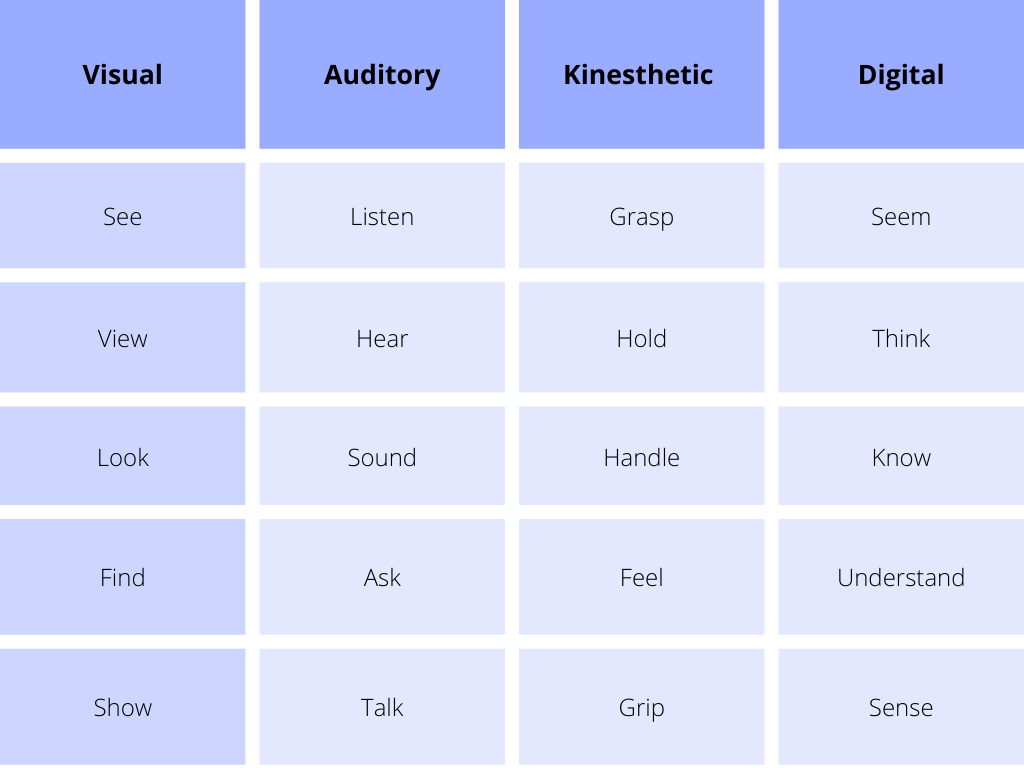
For the moment, identifying representational systems begins by listening for the predicates that people use in their language. See the table of predicates below.

Obviously, donโ€™t practice this in the most important conversation of your life. When you are learning to do something, your capacity to process content is reduced. So if you are having an important life changing conversation, attend to that. When you are having coffee with a friend or listening to your friends talking to one another or even watching a movie, listen for the predicates.

Once you are comfortable listening for the predicates, then start to formulate pacing responses. You can do this in your mind, or on a piece of paper. The important thing is practice.

Once this is easy to do, then start delivering some of your pacing responses. It can be as simply as โ€œI seeโ€ or โ€œI hear youโ€ or โ€œI get where you are coming fromโ€ or โ€œI know what you meanโ€.

One last thought. You will probably find one representational system that is easy for you to identify and to pace. This is probably the one that you are most comfortable with. Do not be content with this. Know which ones are less familiar to you and work on those. It will pay dividends.

The next entry (Part 2) will provide readers some other ways of identifying representational systems. But for the moment, enjoy practicing this entryโ€™s skills. I trust you will find it helpful!


To learn more about how Neuro-Linguistic Programming can help you, join us on the journey towards solving "The People Puzzle" - Prof Joel's flagship NLP training series. Obtain the blueprint to achieve greater self-awareness, enhance communication with others, and connect with people more effectively.

Unlock the People Puzzle today! 👉 https://peacemakers.sg/the-people-puzzle/
neurolinguists toolbox

A Neuro-Linguist's Toolbox - Rapport: Non-Verbal Behaviours

On 12 February 2018, our Training Director, Professor Joel Lee, published a blog post on the Kluwer Mediation Blog entitled "A Neuro-Linguist's Toolbox - Rapport: Non-Verbal Behaviours". His blog post is reproduced in full below.


A Brief Recap

This entry is an ongoing series focused on using Neuro-Linguistic Programming in our practice of amicable dispute resolution. For ease of reference and the convenience of readers, I will list in this and subsequent entries the series and links to it.

  1. A Neuro-Linguist's Toolbox - A Starting Point and Building Rapport

In this, the second in the series, I would like to focus on how one can build rapport using non-verbal behaviours.

A Breakdown of Communication

In our field, it is trite that non-verbal communication is as important, if not more important, than verbal communication. Put another way, how we say something is sometimes more significant than what it is we say. A commonly cited study lists the components of communication as:

Physiology: 55%
Tonality: 38%
Words: 7%

While there have been criticisms of the study size and demographic and even disagreements about the exact percentages, the two main points that I would highlight from the study remains. First, that physiology and tonality (the non-verbal behaviours) form a larger proportion of the communication package than the spoken word. Secondly, where the spoken word is inconsistent with the non-verbal behaviours, we tend towards believing what is unspoken.

Iโ€™m sure we have all had the experience of communicating with someone where their physiology and tonality (non-verbal behaviours) do not match their words. Someone could be saying โ€œIโ€™m okโ€ when it is extremely clear from their non-verbals that they are anything but โ€œokโ€.

Ok... why does it matter?

From the perspective of negotiation and mediation, it is useful in 2 ways. First, this incongruence in communication often gives us a clue that there is something more that needs to be explored. Perhaps there is an interest to be uncovered or an unhappiness that is yet to be voiced. Secondly, it becomes important for us, as professional communicators to be as congruent as possible.

As you read this, some of you may say โ€œIsnโ€™t this body language?โ€. In a sense, it is and it isnโ€™t. Much of mainstream literature relating to body language leads people to think that discrete meanings can be derived from the gestures we make or the postures we take. The phrase โ€œbody languageโ€ itself contributes to this idea. Hence, one often hears generalizations like โ€œCrossed Arms or Legsโ€ means that the person is defensive or closed to new ideas or โ€œTouching their mouthโ€ means that the person is lying.

I donโ€™t know if these equivalences drawn are accurate or not. And that is the point. To say that these generalizations are universal cannot be right, especially if one takes into account the differences across genders and culture.

To be fair, some of the more nuanced pieces on body language talk about looking for non-verbal clusters, congruence and to be sensitive to culture and context. A person crossing their arms might not be defensive but simply cold. Context matters when making meaning.

How NLP comes into play

NLP approaches non-verbal behaviour from a different perspective. Can you remember a time you were having a wonderful conversation with someone? The kind where time seems to fly? You may have noticed that at these times you and your companion might have been speaking at the same rate or sitting in the same way or making the same gestures or using the same phrases? Or perhaps you might be a people watcher at a restaurant or a cafรฉ and have noticed that you can tell whether the groups were getting along by watching whether their non-verbals were synchronized or not.

In NLP terms, we describe this state of synchronization as being in rapport. It should not be surprising that people who get along will synchronize their behaviour, both verbal and non-verbal. What might be more surprising to some is that, building on the idea that human interaction is systemic, the reverse is true. NLP suggests that one can build systemic rapport by pacing the other personโ€™s non-verbal behaviours.

This means that when a person sits a certain way, one can subtly sit in a similar if not exactly the same way. When a person uses a particular gesture when speaking, one can subtly match that gesture when speaking. If a person speaks at a particular speed, one can speak at the same speed.

Learning to Pace

Pacing is achieved through matching, mirroring and cross-over mirroring. The first two are best illustrated with an example.

Matching

If the person you are seeking to pace is seated with his left leg crossed over his right, tilts his head to his right when he talks and gestures with this right hand when he speaks, matching involves manifesting oneโ€™s non-verbals in the same way right down to the left and rights of it.

Mirroring

Mirroring is the same thing, except that one manifests oneโ€™s non-verbals in the same way but in reverse. So one would sit with the right leg crossed over the left, the head tilted to the left and gesturing with the left hand when speaking. It is like being a reflection of the person in a mirror.

When teaching this, I often use the metaphor of a radio transmitter. In order to receive transmissions from that transmitter, we need to know what frequency they are transmitting on. Their non-verbals is the frequency and in order to build rapport with them, we need to tune our non-verbals to the same frequency. Following from this radio metaphor, just as we can still receive transmissions even if our radio is not tuned exactly to the same frequency (as long as it is close enough), the same is true here. We donโ€™t have to sit in exactly the same way or gesture with exactly the same enthusiasm. As long as they are similar enough, systemic rapport can still be established.

At this point, it is important to make clear that the purpose of matching/mirroring is not to mimic or make fun of the other person. This will lead to the opposite outcome of destroying rapport. One must match/mirror subtly and with respect for the other person. As with most things in life, Intention matters.

Cross-Over Mirroring

Apart from directly matching/mirroring the other person, it is also possible to match one aspect of the personโ€™s non-verbal communication with another aspect of your non-verbal communication. This is known as cross-over mirroring. The most common application of this is to speak at the speed at which the listener is nodding or vice versa, to nod at the speed at which the other person is speaking. The writer uses this often and to good effect.

What specific parts of Non-Verbal Behaviour can we Pace?

In terms of Physiology, we can pace:

  • Posture (How one holds the head and body)
  • Gestures (Movement of the hands, usually when speaking)
  • Facial Expression (Smiles, frowns, etc)
  • Breathing.

Of these aspects, posture, gestures and facial expressions are easiest to pace.

It is useful to note two things here. First, pacing posture, facial expressions and breathing are synchronous. In other words, it is happening at the same time. Pacing gestures however is not synchronous. People generally gesture when they speak. It would be very odd for you to gesture synchronously when they speak! The idea therefore is for you to pace their gestures when you speak.

The second relates to breathing. This is hard for most people to track and many tend to stare at the chest of the speaker to try to identify their breathing patterns. This is not recommended, and inappropriate even before the age of #metoo. There are two clues to identifying the breathing pattern of the speaker. One is to look for the rise and fall of the speakerโ€™s shoulders. Many adults breathe in the upper one-third of their lungs. Their shoulders will inevitable rise and fall with their breath. The other clue is that people generally breathe out when they speak. So, if one was minded to pace the speakerโ€™s breath, one can breathe out when they are speaking and take a breath when they do.

In terms of Tonality, we can pace:

  • Tone (How high or low oneโ€™s pitch is)
  • Tempo (How fast or slow and how rhythmic one speaks)
  • Timbre (How clearly or distorted the quality of oneโ€™s voice is)
  • Volume (How loud or soft one is speaking).

Of these, tempo and volume are easiest to pace.

It is useful to note three things in relation to pacing tonality. First, and to state the obvious, pacing tonality is asynchronous. You can only pace when it is your turn to speak. Secondly, when pacing tone, one does not have to achieve the same pitch as the other person. For example, if the other person was had a particularly low pitch, it would be absurd to expect a woman to achieve the same pitch. All she needs to do is speak at the lower end of her tonal register. Third, people often have reservations about pacing volume. They are concerned that by raising oneโ€™s volume, it will add to the conflict.

Building Rapport

This is when the notion of โ€œleadingโ€ (which was discussed in the previous entry) comes in. Briefly, while pacing helps us build rapport, building rapport isnโ€™t the ends but is simply the means. Rapport is only useful when it allows us to lead our counterpart or the parties some place more useful.

Going back then to the concern about raising oneโ€™s volume, in order to deal with someone speaking loudly and aggressively, the trick then is pace the volume and accompany it with words that are non-confrontational. Once the pace is made (which can happen in the course of a couple of seconds), then one needs to lead the volume downwards. This must be done gradually, in small steps otherwise, the speaker might not follow. And when they do follow, sometimes, they will follow you all the way down or just part of the way. In the latter situation, simply re-pace at the new level and lead again.

When practicing this in NLP workshops, participants are often surprised about the efficacy of this method.

Putting to Practice!

Needless to say these are just words on a page and has very little use (apart from serving an informational function) unless we put it into practice. I would like to suggest a number of exercises one can undertake to practice these skills.

Physiology

1. Sit at a cafe and watch people. Observe whether their physiology are in synchrony.
2. Find a particular person sitting at another table and pace their physiology for 5 mins. Then pick another. And another.
3. Work with a friend who also wishes to practice pacing. Sit or stand across from each other and take turns pacing their physiology. You can pace the entire physiology or isolate certain components to practice.
4. Practice this in real time with an unsuspecting friend. It is crucial to remember that you are seeking to pace not mimic. respect the person you are pacing. Intention matters.

Tonality

1. Find a talk show on YouTube and isolate a certain phrase that the host typically says. Then practice pacing the components of tonality with that phrase, seeking to replicate it exactly. Then practice with different phrases until it becomes smooth and easy.
2. Work with a friend who also wishes to practice pacing. Take turns speaking a phrase and pacing it. Again, you can match the entire tonality package or isolate certain components to practice.
3. Practice this in real time with an unsuspecting friend. Again, pace respectfully, donโ€™t mimic. Intention matters.

I hope this entry has provided a useful primer for building non-verbal rapport and that readers might take the time to practice the skills until they become part of their unconscious competence. Have fun!


To learn more about how Neuro-Linguistic Programming can help you, join us on the journey towards solving "The People Puzzle" - Prof Joel's flagship NLP training series. Obtain the blueprint to achieve greater self-awareness, enhance communication with others, and connect with people more effectively.

Unlock the People Puzzle today! 👉 https://peacemakers.sg/the-people-puzzle/

neurolinguists toolbox

A Neuro-Linguist's Toolbox - A Starting Point and Building Rapport

On 12 January 2018, our Training Director, Professor Joel Lee, published a blog post on the Kluwer Mediation Blog entitled "A Neuro-Linguist's Toolbox - A Starting Point and Building Rapport". His blog post is reproduced in full below.


A Starting Point

Over the years that I have written for the Kluwer Mediation Blog, I have dipped, from time to time, into the field of Neuro-Linguistic Programming (NLP). And I have received requests from readers to write more about NLP and how it can assist us in our practice of amicable dispute resolution whether mediation or negotiation. This has also coincided with my 2018 resolution to work towards publishing a book on tools from NLP for conflict resolution.

So where possible, and with the indulgence of readers, I will seek to devote my monthly Kluwer Mediation Blog entries towards one aspect of a Neuro-Linguistโ€™s toolbox for conflict resolution. This is of course subject to the caveat that where there is something extremely topical, I may choose to depart from this self-imposed practice and devote that monthโ€™s entry to that topic.

A Brief History of NLP

Before diving in, for those who might be unfamiliar with NLP, I think it is important and useful to provide a brief background here so that readers who are interested in finding out more can explore the literature and trainings available.

NLP was the brainchild of John Grinder and Richard Bandler. In the early 1970s, they and, later, their students set out to study people who excelled in their respective fields and those that did not. They were interested in finding out what โ€œthe difference that made the differenceโ€ was. Put simply, NLP was a methodology for modelling human behaviour. As a result of their initial modelling attempts with therapists, they identified certain patterns of behaviour that allowed these therapists to achieve seemingly miraculous results with their clients. Grinder and Bandler found that they could replicate and even enhance these results when they utilized and modified these patterns of behaviour. The NLPers, as they have sometimes come to be referred to, went on to model other examples of excellence that cover teaching, sales, managing, healing, and sports, just to name a few.

Well... does it actually work?

To be entirely transparent, there are many detractors of NLP. There is an entire skepticโ€™s page devoted to debunking NLP. It has been criticized by scientists as pseudoscience and even the field of Neuro-Science (whose research is confirming many of the things that NLP has been proposing) has chosen to distance itself by saying that the propositions in NLP are not steeped in science. And here I was thinking that scientists were supposed to be open-minded.

My mission here is not to defend NLP. As the internet saying goes, โ€œhaters will hateโ€. From my perspective, NLP has never claimed to be a science. It is a model, which in my experience works. I am pretty sure that there is no scientific evidence that โ€œmediation worksโ€. But I know that it works, as do many readers of this blog. And interestingly enough, you do not have to believe that it works, for it to work. You just have to genuinely try it out. And this is what I invite readers to do.

Having said my piece, I want to devote the rest of this monthโ€™s entry to some general thoughts on building rapport from an NLP perspective and then expand on this in future entries.

Building Rapport

A key part of NLP is the process of building rapport. The basis upon which rapport works is based on the idea that people like people who are like themselves. As the adage goes,

โ€œBirds of a feather, flock togetherโ€. - William Turner

I know that some readers at this point are saying โ€œbut what about โ€˜opposites attractโ€™โ€? Opposites do attract, especially if you are a magnet. But consider that when you meet someone for the first time (for example, when you, as a mediator meet parties), we often look for whatโ€™s the same. Finding something in common is a powerful way to connect with someone else. Some would suggest that the urge to seek out what is familiar is a powerful drive for humans. For some, this drive can be so strong that it can cause them to resist change. Ironically, we (as mediators) face this problem every time we try to get parties to move away from the familiarity of the problem they are having towards considering new (and therefore change) ways of thinking and solutions.

Fortunately, NLP provides a simple (albeit not simplistic model) to build and utilize rapport. The process starts off with โ€œPace-ingโ€ (misspelling deliberate) the other person. Once sufficient rapport has been established, one can then to โ€œLeadโ€ the other person towards more useful ideas or behaviours.

What is "Pace-ing" to then "Lead"

It is sometimes easier to illustrate this metaphorically. Many people run as a physical activity and there are a number of ways to get someone to increase their running speed. One way is that some people are self-motivated. They simply increase their speed. Others might increase their speed because someone might be shouting at them or if they perceive someone catching up to them. However, one way to help them increase their speed subtly is to run with them at their speed. More accurately, run with them at their pace. Once a joint rhythm (or rapport) is established, the pacer can subtly increase their pace and more often than not, the person being paced will follow.

This is essentially what the rapport building model seeks to do. Pace and Lead. It is important to note at this point that unless building rapport is your only goal, pacing by itself is insufficient. One needs to take that rapport and lead the other person somewhere more useful.

What can one pace? Most of us seek to establish commonality via content. We will talk to someone and make a connection through the people we know, the schools we have attended, the books we have read, the places we have lived, the experiences weโ€™ve had, etc. And that is absolutely fine. Content-based rapport is useful in social settings where we have the luxury of time to explore these matters.

However, there are many other aspects of the human โ€œbe-ingโ€ (again misspelling deliberate) that we can pace. I offer you a list of possible aspects below, which I hope to explore in more detail in future entries.

1. Non-Verbal Behaviours

This denotes our physiology and tonality. I have explored pacing physiology in June 2012 and the impact of tonality on communication in August 2013.

2. Representational Systems

NLP posits that we take in information through five channels and process it via six modalities. These are referred to as representational systems. The representational systems can be paced.

3. Values and Beliefs

Put simply, values are what we hold as important to us. We may have different sets of values for different contexts in our lives, or they may be fairly homogenous. For each of these values, there will be beliefs related to those values. These can be paced.

4. Meta-Programs

These are sometimes referred to as personality preferences and I have done an initial exploration of how these personality preferences interact to produce conflict in October 2017. Meta-Programs are the content-free filters through which we view the world. A common example used is โ€œwhether the glass is half full or half emptyโ€. Both answers are correct. They are just different when seen through different filters. Therefore, pacing how someone sees the world is yet another way to build rapport.

5. Metaphors

Humans are meaning-making and there is some suggestion that the human brain works associatively and metaphorically. These metaphors are far more than figures of speech, they represent how interpret the world and affect the narrative through which we interact with it. Deep rapport can be built oneโ€™s metaphorical world was paced.

6. Linguistic Patterns

Finally, the linguistic patterns we have can be paced. This may be in the form of fillers that we use or certain turns of phrases or a particular linguistic structure.

Thanks for reading. I do hope that this series will be of interest to readers and provide some extra
tools in their tool box.


To learn more about how Neuro-Linguistic Programming can help you, join us on the journey towards solving "The People Puzzle" - Prof Joel's flagship NLP training series. Obtain the blueprint to achieve greater self-awareness, enhance communication with others, and connect with people more effectively.

Unlock the People Puzzle today! 👉 https://peacemakers.sg/the-people-puzzle/
6fuc7u

Mediation and Conciliation, same same but different?

By Mervyn Lin

The rise of alternative dispute resolution (ADR) in the legal sector cannot be understated. Offering greater autonomy, flexibility, and cost-efficiency in tackling disputes compared to litigation, it is no surprise that more and more parties are utilising ADR mechanisms. Recognising this shift in the legal landscape, the Singapore courts have begun promoting different forms of dispute resolution to suit the specific needs of disputants. As of 1 April 2022, the courts have officially recognised conciliation as the latest ADR mechanism which parties may opt for.

Conciliation is a form of dispute resolution where parties elect a neutral third party (i.e. a conciliator) to aid in arriving at a mutually agreeable settlement rather than going to trial. But hold on, does this not sound strikingly similar to the established practice of mediation? In fact, the Singapore Mediation Act also barely differentiates the two processes. Yet, while both processes are rooted in similar concepts, each aims to aid parties through fundamentally different means. This post will clarify the similarities and differences between the two in Singaporeโ€™s context.

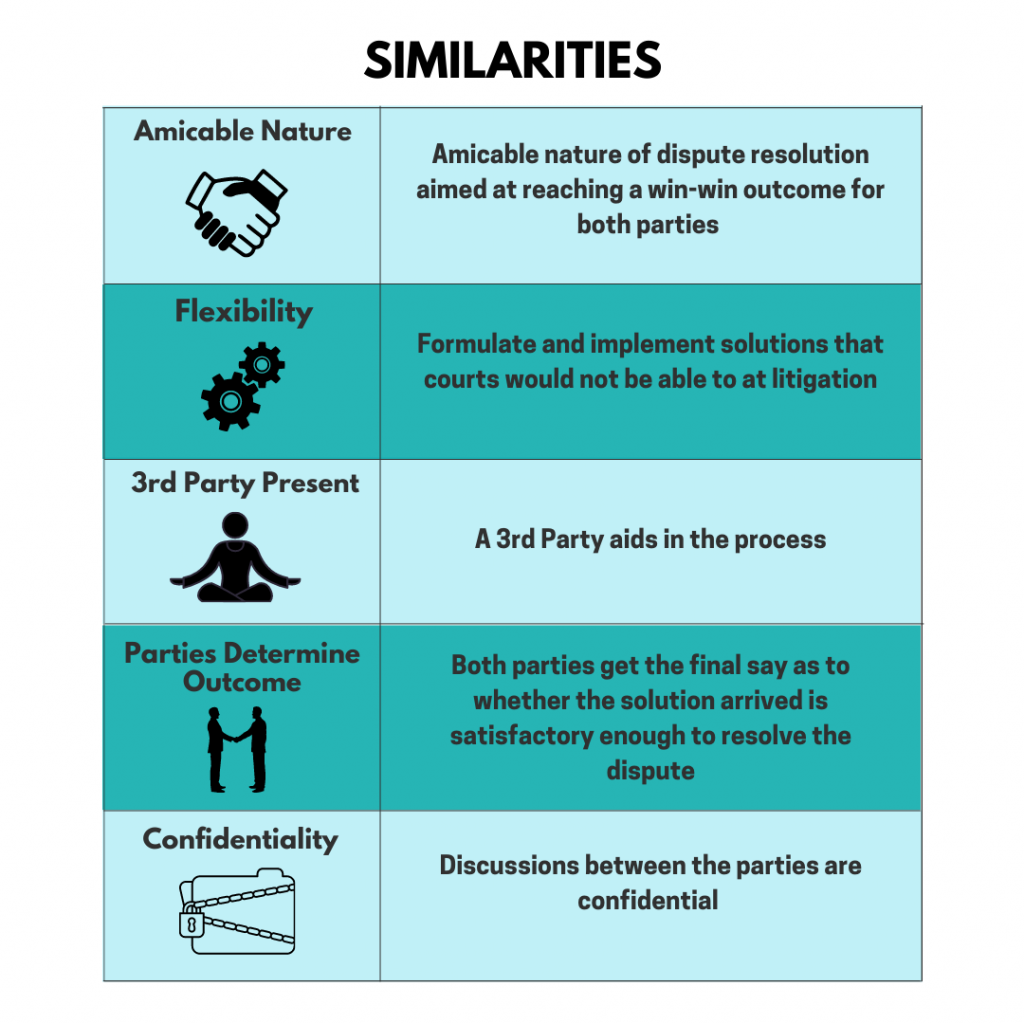
Let's begin with the similarities:

(1) Amicable Nature
Both conciliation and mediation are amicable in nature and are grounded in preserving relationships. They aim for win-win solutions which preserve the partiesโ€™ relationship whilst effectively resolving the dispute at hand.

(2) Flexibility
Both processes are flexible in nature. They are able to formulate and implement solutions which would simply be impossible for the courts to do effectively.

(3) Third Party Present
Both processes involve an elected third party to aid the parties in reaching a resolution to the dispute. In conciliation, this third party is known as the conciliator. In mediation, the third party is known as the mediator.

(4) Party Autonomy
Parties can choose to use either process if all other parties agree to it. Parties in both processes get the final say as to whether the solution arrived at is satisfactory for their cause, i.e. no solution is binding unless all parties agree to it, and the success of the process rests largely on them.

(5) Confidentiality
Both conciliation and mediation are confidential in nature. This means the discussions between parties during a conciliation or mediation session will be confidential. If parties reach a settlement, they may also decide to keep the details of what they have agreed to confidential.

Now although similar in many ways, there is one key difference between the two processes โ€“ the role of the third party.

In a mediation, a mediator is there to facilitate and guide the parties through the discussion. The mediator manages the flow of the conversation, and aids the parties in identifying and articulating their underlying interests. Ultimately however, the parties will discuss the issues between themselves, before brainstorming and arriving at any possible solutions. At its core, mediation is still a party driven process.

In a conciliation, a conciliator is there to not only guide the conversation, but also to play an active role in sharing advice and possible solutions to the dispute at hand. The conciliator will lend their expertise in evaluating the situation and plays a more direct role in generating solutions to resolve the dispute. Parties therefore play a more reactive role in conciliation, building on and refining suggestions provided by the conciliator, although they are still in control of whether to settle the dispute and the specific details of their settlement.

In practice, conciliation is a suggested follow up to mediation in situations where parties are unable to suggest and arrive at satisfactory solutions. Allowing the third party to play a more active role in the discussion may lead to the discovery of new solutions that may not have been contemplated in the preceding mediation.

Now that you know what the similarities and differences between mediation and conciliation are, you can better choose the process more suited for your own unique circumstances. Make your choice wisely!


Peacemakers offers the services of internationally accredited mediators with extensive experience in resolving local and international conflicts. If you are involved in a dispute, let us know your requirements via email at mediate@peacemakers.sg, and we will recommend you the mediators that best meet your needs!

And a little child shall lead them 2019 - FB

And A Little Child Shall Lead Them โ€“ Peacemakers 2019

On 12 July 2019, our Training and Development Advisor, Professor Joel Lee, published a blog post on the Kluwer Mediation Blog entitled โ€œAnd A Little Child Shall Lead Them โ€“ Peacemakers Conference 2019โ€. His blog post is reproduced in full below.


I have in previous entries (July 2012 and July 2013) written about a peer mediation initiative called the Peacemakers Conference. The purpose of the Peacemakers Conference is to teach 13-16 year olds how to resolve conflicts amicably in a workshop cum competition format. This yearโ€™s Peacemakers Conference was held from 17 to 19 July 2019.
 
As in previous years, we asked students from different schools to work together to create a visual metaphor for mediation. This started in 2015 and has become a regular feature in the Peacemakers Conference. Metaphors from previous years be found in the entries for November 2015August 2016July 2017 and July 2018.

This year, the students came up with 7 visual metaphors which I would like to share with readers in this entry. For each of these, images or videos of the metaphor are shared along with a description of the metaphor.

I would like to acknowledge the efforts of Mr. Sean Lim and the Peacemakers Facilitation team for capturing the the description and images of each of the metaphors that appear below.

1. Mediation is like a Wire

Mediation is like a wire; it connects the handphone to the portable charger. In the case of mediation, when the two parties come together, the mediation session helps them to connect with each other, so that they can find a solution that is agreeable to the both of them. It helps the two parties to work together and cooperatively to reach a certain desired outcome. Just like mediation, a wire connects two appliances together. In mediation, the parties bring two opposing points of view and what they want is very different. This is similar to a phone and portable charger. They are very different things and they serve different purposes. The wire helps them both to achieve their purposes.

2. Mediation is a Flying Cow

Is it a bird? Is it a plane?

NO, itโ€™s a FLYING COW!

Indeed, mediation is a like a flying cow. You might be thinking, holy cow! What a strange metaphor. How is a flying cow related to mediation? Well, the two actually have more in common than you think, especially whenever two parties have beef with each other.

Firstly, a flying cow represents the 3 core pillars of mediation: neutrality, confidentiality, and party autonomy.

Neutrality: The cow is not biased towards any farmer, as long as it is well fed and taken care of, which represents how mediators are not biased towards any party and are an impartial third party. Their hooves are split into 2 equal parts, and their weight is distributed equally on both of these, which shows how the cow is even and fair.

Confidentiality: Have you ever heard a cow talk? Neither have we. This ensures the contents are always secret and private, maintaining confidentiality: everything that goes into the cow, will stay in the cow, just like what is said in the mediation will stay in the mediation.

Party Autonomy: With wings, the cow also has the freedom to fly wherever it wants and these allow it to choose and commit to a destination. Also, the wings can allow it to fly and look at the situation from different perspectives and find a solution. Similarly, parties voluntarily generate their solution which they have ownership of. This represents party autonomy!

Secondly, the cow also represents the mediation process itself as it has four stomachs. When the cow eats, it first chews the food just enough to swallow. The partly chewed food travels to the first two stomachs, where it is stored. These first two stomachs represent the first two steps in the mediation process, opening and information gathering+checking as all the food has not been digested yet, just like how the information still needs to be processed and reframed by a mediator (which are like enzymes in the stomach). Here, the information is still being broken down, and parties may face conflicts or misunderstandings, similar to how cows may face indigestion.

When the cow is full from this eating process, it rests. This is akin to how sometimes, parties may get physically or emotionally tired from the long processes and mediations and may need a break after passionately conveying their feelings. Later, the cow coughs up bits of unchewed food and chews them completely before swallowing again. The food then goes through the third and fourth stomachs, where it is fully digested. This is just like how all of the secrets, which are represented by the unchewed food of the cow, will need to be brought up and broken down further into their underlying problems and interests in order to continue on with a successful mediation. Since cows chew and digest their food very thoroughly, it represents the skill and depth with which a mediator must understand the issue at hand so as to guide the parties to a realistic solution. Finally after all the information has been uncovered and a solution has been found, the mediation can be closed, similar to the fully digested food in a cowโ€™s fourth stomach.

As the food passes through the cowโ€™s four stomachs, only the nutrients from food will be absorbed, while harmful and irrelevant substances will be excreted asโ€ฆ bullshit. This is parallel to mediation; what remains is only positive and valuable information, while the negative and irrelevant sentiments are discarded or reframed during the process, so both parties can mOOve on a happier note.

Lastly, cows are known for their milk. Milking a cow is hard work but no doubt worth it because the milk obtained is really precious. After thinking hard, the 2 parties will be satisfied with the milk of their labours and the mediator is rewarded with the satisfaction of mending a strained relationship. Cows may face stress if they are separated from their herd, or have a change in environment. This is similar to how mediation can sometimes be stressful, because of the high steaks situation, but these feelings get better eventually, just like a calm cow.

3. Mediation is a Life Form

It is the only reason why nature is alive. The reason why we have the environment around us. Why animals have emotions. Why animals live, grow and die. Life form is the only thing that divides the world of living and the dead.

The reason we chose the metaphor of the heart is because all living things have a heart, visible or not. Like a shell, the heart is not alive. The veins that represents life form. They are the reason why the heart is alive.

Just like the deoxygenated blood enters the heart through the veins, mediations first starts off as a conflict entering mediation. Just like how we need to get rid of the deoxygenated blood, we come in into a mediation with conflicts that we hope to resolve.

And the blood exits filled with oxygen โ€“ just like in a mediation, where the parties come out with a solution and certainly feeling better.

The heart is necessary to keep all creatures alive, just like mediation is important to sustain relationships and solve problems. The feelings we feel from our hearts are just like a mediation is filled with the emotions of parties.

Emotions may cause arguments, but it could also cause an argument to be resolved. Being alive. Being in this world. Allows you to think, sympathise and empathise with the other which are the reasons why arguments are resolved.

But being alive. But being in this world. You will have different perspectives which lead to arguments. Positivity and negativity do exist within us, and they are what makes us who we are.

This is why we chose life forms in a form of a heart. We chose 3 different hearts and as you swipe you can see how a negative situation can be turned into positive situation through mediation. As the colours slowly seep through the veins it shows the progression of how things surely will get better after a mediation.

Life forms. Being alive. We will be the reason why fights happen but mediation shows us how people can also resolve their fight together. Because mediation is bringing in dark problems but coming out with bright possibilities.

4. Mediation is a Microscope

Mediation is like a microscope 🔬.

The more 🔍zoom in🔎, the bigger the picture gets. The more you focus, you clearer you see 👀.

Whenever you use a microscope, the first thing you have to do is prepare your specimen. Similarly in mediation, you have to ensure that both parties are clear about the mediation session so that they can be prepared to cooperate.

Next, you have to examine your slide. When you look through the microscope, it is similar to how a mediator listens carefully to the partiesโ€™ opening statements and hears what they are saying, in order to see the big picture and understand the issues. The microscope also has different lenses to allow the viewer to see different things. The more you look, the clearer it is.

The mediator should also choose an objective lens, by being clear about what objectives the parties want to achieve after the session.

The microscope also requires a light in order to allow you to see clearly. Similarly, although parties may not always understand each other, the mediator sheds light on the issues to help them understand each other better.

In order for the light to reach the specimen, you also need a condenser, which is similar to the mediatorโ€™s function of summarizing. When you zoom in, sometimes what you see is not clear. In order to get the clear picture, you need to focus on asking open-ended questions, such as the 5W and 1H.

Finally, the last step is problem-solving. Once the mediator has identified the underlying problem, the mediator can help the parties problem-solve, giving them the autonomy to suggest solutions.

5. Mediation is a Lighthouse

When two ships 🚢 are lost at sea and are battling the rocky waves 🌊, lacking any light 💡 to guide them, they drift further and further away from their destination โ€“ the shore 🏝

This is similar to how without mediation, two opposing parties will be battling their unresolved issues (rocky waves 🌊) and will find it hard to resolve their problems, and will end up simply causing further misunderstandings and get worse. ☹️

Moreover, in the darkness 🌘, the ships may crash into each other and cause damage to each other, and themselves.

Similarly, without mediation, actions by both parties may result in hurt on both ends 😔, causing harm to their relationship 😰

Therefore, mediation is a lighthouse, because just as how a lighthouse guides ships 🚢 lost at sea who are at risk of being damaged due to the harsh waves and rocks, mediation helps two parties SEA clearly, water-ver the problem.

Mediation allows you to brave the harsh waves of conflict against all odds and eventually come to an agreement ❤️✨ just like a lighthouse shines light on the solution! (water!) 💦💦

6. Mediation is like Braces

The reason as we think mediation is just like braces is because braces bring teeth closer together, just like how mediation brings people closer together. The gaps between the teeth are just like the gaps between the relationship of the two parties, which is brought closer together by braces/mediation.

The pain that comes in the process of having braces is just like the pain of disputes between the parties. It might seem tough, but eventually, after the pain, the outcome is a beautifully straight row of teeth, just like how the relationship of the parties are made to be beautiful.

The retainers that come after braces ensure that the teeth donโ€™t become crooked again, just like how the parties will keep to their solution and carry it out!

7. Mediation is like a Rainbow

Mediation is like a rainbow, which connects both the sun and the rain cloud. The sun and cloud are very different, they are basically natureโ€™s polar opposites. On their own, they represent each extreme โ€“ the sun is very hot, while the cloud is very rainy.

But somehow, the rainbow manages to connect both and the two can form the fruitful conclusion of a pretty rainbow.

Neutrality. The sun does not care about what kind of clouds there are, big or small. Neither do the clouds care what kind of sunlight shines upon them. Either way, a rainbow will still be formed. When the sun and rainbow meet, it signifies that no matter the conflict is, it is possible for the mediator to step in and resolve the conflict.

Party autonomy. The rainbow forms only because the sun and the rain come together as one, and not due to any other reason. This signifies how both disputing parties have ownership of the situation and come together to solve the problem on their own.

Confidentiality. When a rainbow forms, it is actually because the light reflects off the water droplets in the air, but the process is not very obvious and cannot be seen. Therefore, this shows how the process of mediation will be kept confidential.
🌈🌈🌈🌈🌈🌈🌈🌈🌈🌈🌈🌈🌈

That brings us to the end of another installment of visual metaphors for mediation! I hope readers found some of these as inspiring as we did!


For more pictures and videos of the Peacemakers Conference 2019, please visit the Peacemakers Facebook Page.

As Singaporeโ€™s leading peer mediation experts, Peacemakers has an extensive track record of managing and delivering conflict resolution training for youth at both local and international levels. If you would like to train your youth to better manage conflict, let us know how we can help via email at mediate@peacemakers.sg.

IMG_2441

Peacemakers Conference 2019 - Report

By Daniel Foo on behalf of the organisers of the Conference

This yearโ€™s iteration of the Peacemakers Conference marked the eventโ€™s 10th anniversary โ€“ a worthy cause for celebration! Taking place from 17 to 19 June 2019, the Conference sought to teach 13 to 16 year olds how to resolve conflicts amicably in a workshop cum competition format.

This year, we were delighted to host participants from Commonwealth Secondary School, Evergreen Secondary School, Raffles Girlsโ€™ School, Hougang Secondary School, Jurong West Secondary School, St. Margaretโ€™s Secondary School and Yishun Town Secondary School.


Learning about Mediation as a Mode of Peacemaking

Over the course of the Conference, the participants were exposed to mediation as a mode of amicable conflict management. Our lead trainers, Mr Mark Lim and Ms Madeleine Poh, trained them in the foundational principles of mediation, the process of peer mediation and elements of collaborative problem solving. Our trainers also focused on the skills involved in managing emotions, active listening and reframing. By the end of the workshops, the participants exhibited a keen understanding of what interests were, and how they were important for parties in conflict to generate sustainable options for resolving their disputes.

Just like in previous years, the participants spent the last afternoon of the Conference on a field trip to the Supreme Court of Singapore. They learned about the history of Singaporeโ€™s judiciary and legal system at the Supreme Court Heritage Gallery and had an interactive experience learning about court proceedings from the perspective of different persons involved in a court proceeding at the Learning Court.


Practising Mediation in Everyday Peacemaking

The participants got to put what they learned into practice through a series of role play scenarios. Over the course of the Conference, they were given hypothetical disputes that could reasonably occur between students in secondary school, and took turns to role play as parties and mediators in these disputes. This was a chance for them not only to exhibit their hidden acting ability, but also to practise their newly acquired mediation skills โ€“ including asking questions, managing emotions and encouraging brainstorming for solutions to problems.

After four gruelling rounds of competition, two teams emerged as the highest scoring participants: St. Margaretโ€™s Secondary School and Raffles Girlsโ€™ School. The two teams competed in a final round at the NUS Law Bukit Timah Campus, where Ankita Alevoor Bhat (RGS), Tay Ee Shuen Megan (RGS), Annika Naomi Ee Rui En (SMSS) and Bathar Nisha Barvin (SMSS) mediated a dramatic and emotionally-charged hypothetical dispute. The finals were judged by CEO of Strategic Moves Pte Ltd, Mr Viswa Sadasivan; Deputy Executive Director of the Singapore Mediation Centre, Ms Sabiha Shiraz; and CEO of Sage, Mr Aloysius Goh.

Both teams put up remarkable performances โ€“ showcasing in particular their ability to ask effective questions. The judges commended both teams for their ability to stay neutral and refrain from suggesting options. The judges also raised the importance of ensuring that both parties feel safe to discuss freely in the negotiation, and that they reach a settlement that both are comfortable with. In the end, the team from RGS was awarded champion for their impressive ability to stay calm and ask effective questions quickly yet sensitively. Besides the prizes sponsored by Singapore Mediation Centre and Singapore International Mediation Institute, both finalists were awarded finely crafted ORIENT watches, kindly sponsored by BIG Time SG.

Additionally, five participants were recognised for their overall attitude and performance throughout the Conference: Hoo Ping Zhi from Yishun Town Secondary School, Malabanan Ace Brendan Malones from Hougang Secondary School, Koya Kavyanjali Sai from Jurong West Secondary School, Wong Ke Ning Clarisse from Commonwealth Secondary School and Ooi Jia Xi from Evergreen Secondary School.


Promoting Mediation as aโ€ฆ Flying Cowโ€ฆ with Braces?

Participants also got the opportunity to get their creative juices by inventing visual metaphors for what mediation is to them. This year saw what could be the most creative submissions. Participants likened mediation to a wire, a microscope, a lighthouse, a rainbow, and even a life form.

After each groupโ€™s presentation on their metaphors, it was decided that the top two metaphors were โ€œMediation is like Bracesโ€ and โ€“ probably the most imaginative metaphor to have ever featured in the history of the Peacemakers Conference โ€“ โ€œMediation is like a Flying Cowโ€. They explained that mediation is like braces because the process can be painful, but it can also bring parties closer and more aligned with each other. Mediation is also like a flying cow โ€“ with each of its four stomachs representing each stage of the mediation process. The cowโ€™s behavioural features also symbolise the principles of mediation, while its wings represent the possibility of reaching a solution.


Concluding Words

The organisers would like to express their heartfelt gratitude to the many people that made the Peacemakers Conference 2019 such a great success. First and foremost, we would like to thank the Singapore International Mediation Institute, the Singapore Mediation Centre, the Community Mediation Centre, the NUS Collaborative Dispute Resolution Club, and BIG Time SG for supporting the Conference. Without them, the Conference would not have been the success that it was.

We would also like to thank all the judges who volunteered their precious time to invest in the participantsโ€™ mediation training. The judgesโ€™ dedication, patience, and wisdom are greatly appreciated, both by the organisers as well as the participants.

Next, we would like to express our special thanks to St. Margaretโ€™s Secondary School for graciously hosting the Conference, and especially to Mrs Foo Kar Hiang for her help with coordinating the event. We would like to thank the National University of Singaporeโ€™s Faculty of Law for hosting the finals. We would also like to thank all the trainers and facilitators, who worked tirelessly to ensure the smooth running of the Conference.

Finally, we would like to thank the participants for their enthusiasm and willingness to learn. They have impressed us with their ability, creativity and potential to be peacemakers in their respective spheres of influence. As the Managing Director of Peacemakers, Mr Sean Lim, said in his closing remarks: our world is filled with strife, and sometimes it can seem overwhelming. But if we can just make a difference where we are โ€“ to our families, our friends and our communities โ€“ we are already making a step in the right direction.


For moreย picturesย andย videosย of the Peacemakers Conference 2019, please visit theย Peacemakers Facebook Page.

As Singaporeโ€™s leading peer mediation experts, Peacemakers has an extensive track record of managing and delivering conflict resolution training for youth at both local and international levels. If you would like to train your youth to better manage conflict, let us know how we can help via email at mediate@peacemakers.sg.

peacemakers_clear

Copyright 2026 © All Rights Reserved