Choosing the Right Mediator

How to Choose the Right Mediator?

Choosing the right mediator for your case is often the first step in the mediation process, and a crucial one. Parties who invest time and effort in choosing the most suitable mediator inevitably increase their chances in finding success at mediation.  Other than the obvious factors of cost (i.e. the mediator’s fees) and availability (i.e. dates), here are 5 simple things to look for when selecting a mediator:


1. Experience

Enquire about the number of cases the mediator has mediated, and their settlement rate. While not an objective benchmark of a mediator’s effectiveness, mediators who have handled more cases typically have experience dealing with a variety of situations, and are widely trusted for their skills.


2. Subject Matter Knowledge

If your case involves technical terminology and requires specialised knowledge, you might need a mediator with subject matter expertise or knowledge of a particular industry. In certain situations, mediators with subject matter knowledge might be more effective, and can make the mediation process more efficient. For example, if your case is legally complex, a lawyer-mediator may be more helpful when discussing legal issues. In most instances however, an extensive knowledge of the law is not necessary to mediate a case.


3. Neutrality

Neutrality is a key characteristic of mediation. It is imperative that the mediation process be facilitated by a neutral and impartial third-party, to encourage parties to feel safe and comfortable enough to speak openly about their issues and concerns, and to explore potential solutions with one another.


4. Language Competency

Communication is paramount at mediation. A mediator must be able to communicate effectively between parties, especially parties who do not speak the same first language, and are from different countries/cultures. Ensure that your mediator can speak comfortably and fluently in your language(s) of choice.


5. International Disputes Experience

In an increasingly globalised world, and with Singapore strengthening its status as a commercial dispute resolution hub, it is increasingly common for parties to come from different countries and legal traditions. If you have a cross-border dispute or a mediation where at least one advocate is from a different jurisdiction from your own, you should consider appointing a mediator with experience in international disputes and who is sensitive to the nuances of cross-cultural interactions.


The benefit of selecting the right mediator for your case is more than just securing a competent and experienced mediator – the fact that the choice is made by mutual agreement has a positive psychological effect in creating a collaborative atmosphere before the actual mediation even begins. The selection process might take some time and effort, but it will be well worth the trouble. Remember to make your choice wisely!

-

Peacemakers offers the services of internationally accredited mediators with extensive experience in resolving local and international conflicts. If you are involved in a dispute, let us know your requirements via email at mediate@peacemakers.sg, and we will recommend you the mediators that best meet your needs!


Sherylynn

Peace Talks - Sherlynn Oh

Hello Peacemakers!

This is the beginning of our interview series, "Peace Talks", in the run-up to Peacemakers Conference 2017. For our first post, we have Sherlynn Oh Min Yee (middle row, rightmost) from Yishun Town Secondary School:

Why did you choose to participate in Peacemakers Conference 2016?

I was chosen by the teacher in charge of the monitor council, Mr Ten to sign up for Peacemaker Conference 2016. Before making my decision, I went to read up about the conference and felt that it would enrich my experience as a monitor. As a monitor, I am supposed to resolve fights and arguments in my class. By signing up for Peacemakers Conference, I will get to learn how to better communicate with my classmates and be more neutral when mediating conflicts.

How was your experience at Peacemakers 2016?

At the start of the Peacemakers Conference, I was rather afraid as I did not have prior experience mediating. I was also worried that I would not get along well with other students from other schools. However, we had ice breakers games to get to know each other and by the end of the Conference, we all became friends!

The Peacemakers Conference was very enriching as I got to role play different characters. The role-playing exercise was the most memorable part of the conference. We had to act as either the party or the mediator with students from other schools and thus had the chance to interact and work with them. The trainers were also there to watch and gave us feedback on how to improve. Through these role plays, I got to experience how both parties would feel which enabled me to be more sensitive with my words when handling an argument in my class.

Could you share with us your experiences being a finalist at the friendly competition!

I did not expect myself to be chosen as a finalist! I was worried that I would make mistakes during the competition. During the finals, my partner and I had to co-mediate a scenario which was roleplayed by the trainers in front of everyone. I was afraid that I would not do well and let the teachers down but my partner kept on encouraging me. In the end, even though I made a few mistakes during the competition, I felt a sense of accomplishment and satisfaction as I managed to apply whatever I had learnt. After the competition, I became more confident when mediating conflicts in my class and felt more courageous to speak in front of a group of people. I was glad that I had the opportunity to participate in the competition as it really enabled me to step out of my comfort zone!

What advice would you give to participants of Peacemakers Conference 2017?

For participants of Peacemaker Conference 2017, do not be afraid to try even if you do not have any prior experience in mediation. Your friends will be by your side supporting you throughout the journey and it will be an enriching experience for you. It is normal to feel nervous and worried at the start, but as you progress, you will slowly build your confidence and be an outstanding mediator. Most importantly, don’t give up when you face any problems and have fun!!

DR_Spectrum2

4 Common Ways to Resolve Disputes

Disputes are part and parcel of life. When matters escalate into a legal dispute, our first reaction is typically to consider taking the matter to court. However, trials are not the only way to resolve a dispute.

There is a spectrum of dispute resolution processes. This ranges from the more informal and collaborative modes, to more formal and adjudicative mechanisms.


Negotiation

At one end of the spectrum we have negotiation. The most flexible of all the processes, parties typically communicate directly with one another in an unstructured discussion, and have to work out a solution between themselves. Negotiations are also usually free.

However, people tend to be emotional, and have their own views about what happened. If not done effectively, speaking and negotiating directly with the other party might result in a stalemate, and prolonged negotiations with no positive outcome can end up escalating tensions.


Litigation

At the other end of the spectrum is litigation, i.e. taking the matter to court. Once taken to court, the dispute will necessarily be resolved when judgment is passed.

Court proceedings are dictated by court rules, hence parties have minimal control over the process. Parties also have no control over the outcome, which is decided by the judge. As the process is adversarial, someone can only win at the other’s expense, hence misunderstandings and tensions are inevitably escalated and relationships worsened during trial. Time and money have to be spent to prepare for and attend trial, and the emotional costs of going through the trial process usually takes a huge toll on parties. Matters discussed and documents disclosed for court proceedings become public knowledge. Courts are bound by precedent (previous cases), and can only award legal remedies such as financial compensation. Even then, court judgments are also often appealed as parties often do not agree with the court’s decision.


Arbitration

Arbitration is similar to litigation, in that parties agree to resolve the dispute by bringing it before a neutral third party, i.e. the arbitrator. Unlike litigation however, parties can decide for themselves who their arbitrators are. Arbitrators have more flexibility than court judges to decide how the arbitration should proceed and what weight to give evidence. Arbitrations are also confidential.

The arbitrator looks into the legal rights and wrongs of a dispute and makes a decision (i.e. an arbitral award). Once the arbitrator has arrived at a decision, it is binding on parties whether they agree with it or not. As in a court case, there is usually a winning and a losing party in an arbitration. Arbitration awards are enforceable in multiple countries under the New York Convention. However, losing parties will always find ways to resist arbitral awards and make it difficult to enforce.


Mediation

Mediation exists closer to the negotiation end of the spectrum. Mediators are independent neutrals who serve as facilitators to negotiations between parties, i.e. they do not decide the outcome for parties. Mediations are voluntary and minimally structured to offer flexibility.

Mediators can offer a neutral perspective to help parties gain new understandings and overcome deadlocks, drawing on their professional experience to support the problem-solving process, while ensuring parties retain full control of the outcome. Mediators are trained to support constructive communication, manage emotions, and prevent conflicts from escalating. All information disclosed at the mediation is confidential and without prejudice. This means that it cannot be disclosed elsewhere, or used against either party in legal proceedings should parties not settle at mediation. Mediations are also almost always cheaper and faster than litigation or arbitration proceedings.

Should parties reach an agreement to settle, the terms will be recorded in a written agreement to be signed by the parties. This settlement agreement is enforceable as a contract, and can even be recorded as a court order under the new Mediation Act. In any case, studies have shown that mediated settlement agreements are unlikely to be breached. In reaching an agreement, each party will have their own interest in performing; otherwise they would not have signed it.


Conclusion

The next time a legal dispute arises, this guide can help you better choose the appropriate dispute resolution mechanism that best meets your needs.

-

Peacemakers is a select network of mediators. Peacemakers mediators have successfully mediated hundreds of conflicts arising between individuals, companies, and governments. 

As mediators and mediation advocates, our settlement rate to date is close to 85%. If you need a mediator, contact us at mediate@peacemakers.sg to see how we can assist you!

Healthcare

3 Steps To Resolving Healthcare Disputes and Medical Complaints

Healthcare is undergoing change at a rapid pace. Medical technology is advancing at an unprecedented rate, while patients are gaining greater access to information and a greater awareness of their rights. Coupled with recent changes in Singapore’s law on medical advice towards a more patient-centric legal test, and we have a landscape with great potential for medical complaints.

If you wish to raise some of your concerns about your medical care or your healthcare provider, here are 3 simple steps you can follow:

Direct Communication

Your first step in resolving any healthcare disputes should be to raise your concerns directly to your healthcare provider. Based on Peacemakers’ experience, the majority of healthcare related disputes can be resolved through direct communication between both parties. Most hospitals have dedicated departments to handle patients’ queries and feedback, and are well equipped to assist patients or their caregivers with any relevant concerns raised.

The benefits of resolving the matter directly are manifold. Patients can highlight their concerns directly to their healthcare providers, clarify their doubts, while saving valuable time and money.

Mediation

Should direct negotiations between patients and healthcare providers not be fruitful, the next step would be to consider mediation. Mediation provides a confidential environment where both patients and healthcare providers can communicate freely and openly, with the goal of working towards a mutually agreeable solution with the mediators’ assistance. Mediators do not decide what parties should or should not do. Rather, mediators facilitate parties’ discussions by offering new perspectives and facilitating unique solutions which address everyone’s concerns.

Mediations are completely voluntary, which means that nobody can be forced to attend mediation. Should parties all choose to attend mediation however, there are important conditions to meet for the mediation to be successful. These include: (i) attendees having authority to settle the dispute; (ii) participation in good faith; and (iii) respecting the confidentiality of all matters discussed for and at mediation.

Mediation is especially suitable for healthcare disputes because of their unique nature. Healthcare disputes tend to be emotionally charged, and may involve large quantum of claims due to medical bills and/or claims for pain and suffering. Mediation provides a platform for parties to share their perspectives and feelings candidly with one another, and for parties to work on developing a customised solution (beyond mere monetary compensation) which meets everyone’s needs.

Litigation

If parties remain unable to resolve the matter after mediation, patients remain free to make a legal claim against their healthcare providers in court. You should look for a lawyer specialising in medical law to help you ascertain the liability of the medical practitioner or institution. Claims can be made for either General or Special Damages. General damages include pain and suffering, loss of future earnings, and loss of earning capacity. Special damages are more easily quantifiable, such as medical bills and related expenses for which documentation has been kept. Ultimately however, even if patients succeed at trial, the courts can only award damages as compensation.

As healthcare disputes involve medical reports and medical experts, they tend to be costlier to litigate and may result in lengthier trials. Thankfully, the Courts in Singapore have acknowledged this and are implementing improvements to its existing protocols. Mediation is thus expected to feature heavily in the near future.

-

Peacemakers is affiliated to a select group of mediators, all of whom are experienced with healthcare and medical disputes. If you believe that you had experienced medical negligence or malpractice, or just have a healthcare-related dispute you wish to speak with someone about, please contact us at mediate@peacemakers.sg to see how we can assist you!

19417157_1199018296892142_9159305351232143657_o

And A Little Child Shall Lead Them – Peacemakers Conference 2017

On 12 July 2017, our Training and Development Advisor, Associate Professor Joel Lee, published a blog post on the Kluwer Mediation Blog entitled “And A Little Child Shall Lead Them – Peacemakers Conference 2017”. His blog post is reproduced in full below.


I have in previous entries (July 2012, July 2013, November 2015 and August 2016) written about a peer mediation initiative called the Peacemakers Conference. The purpose of the Peacemakers Conference is to teach 13-16 year olds how to resolve conflicts amicably in a workshop cum competition format. This year’s Peacemakers Conference was held from 19 to 21 June 2017.

As in previous years, we asked students from different schools to work together to create a visual metaphor for mediation. This started in 2015 and has become a regular feature in the Peacemakers Conference.

This year, the students came up with 8 visual metaphors which I would like to share with readers in this entry. For each of these, an image of the metaphor is shared along with a description of the metaphor. Readers can also watch these students present their metaphors at the Peacemakers Facebook page.

I would like to acknowledge the efforts of Ms. Jennifer LIM Wei Zhen for capturing the description of each of the metaphors that appear below.

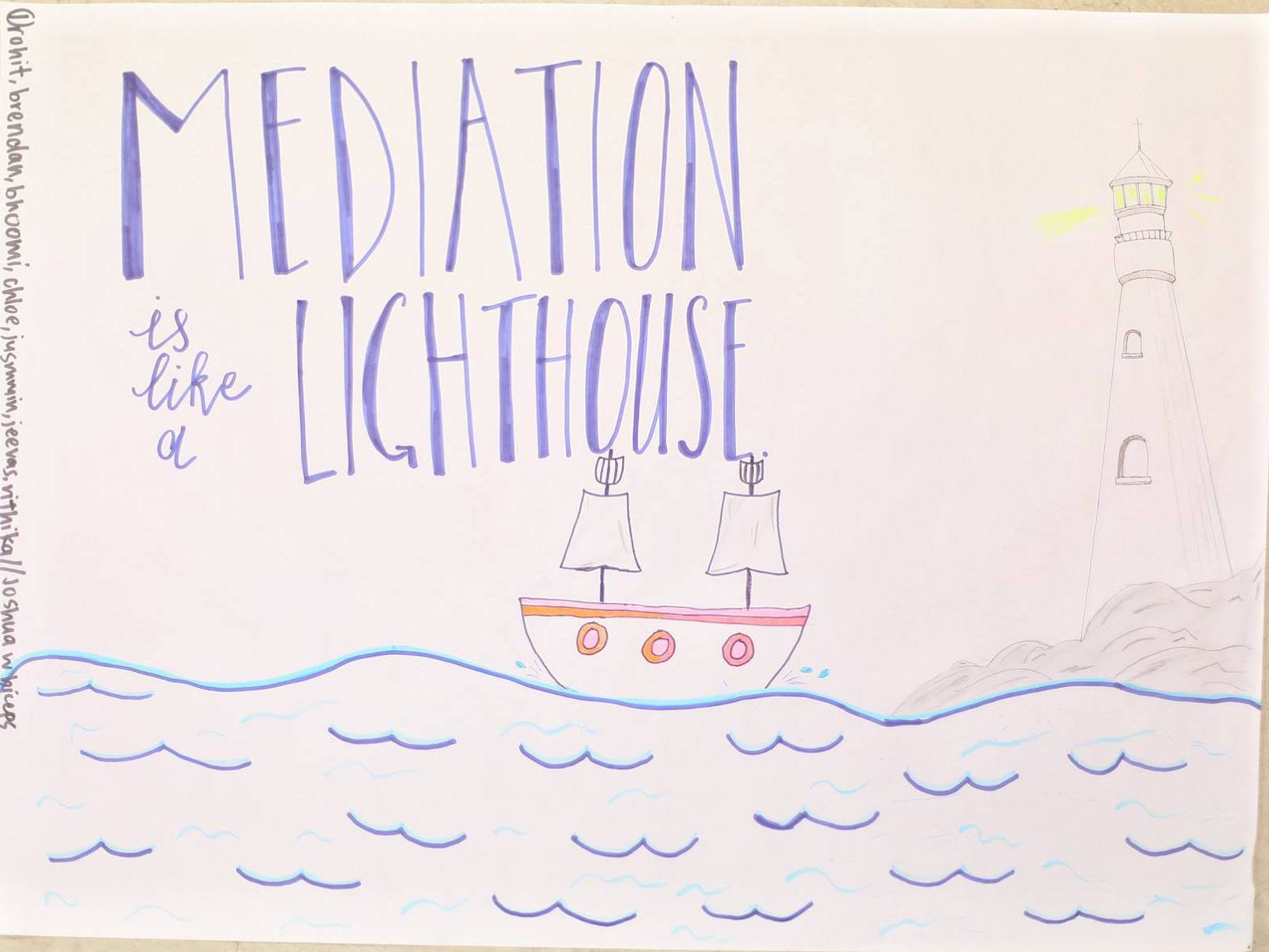
1. Mediation is like a lighthouse

Mediation is like a lighthouse, that provides illumination in the dark night. It guides ships safely to shore by providing light that penetrates the dark. Similarly, mediation guides conflicting parties to an agreement. It provides the signal of hope to their final destination: the shore that promises safety.

Mediation guides parties in conflict to get over their sea of difference and anger, to reach the place of safety: the shore where family is: bringing conflicted parties home with the bright light of mediation – because they care and hope is rekindled.

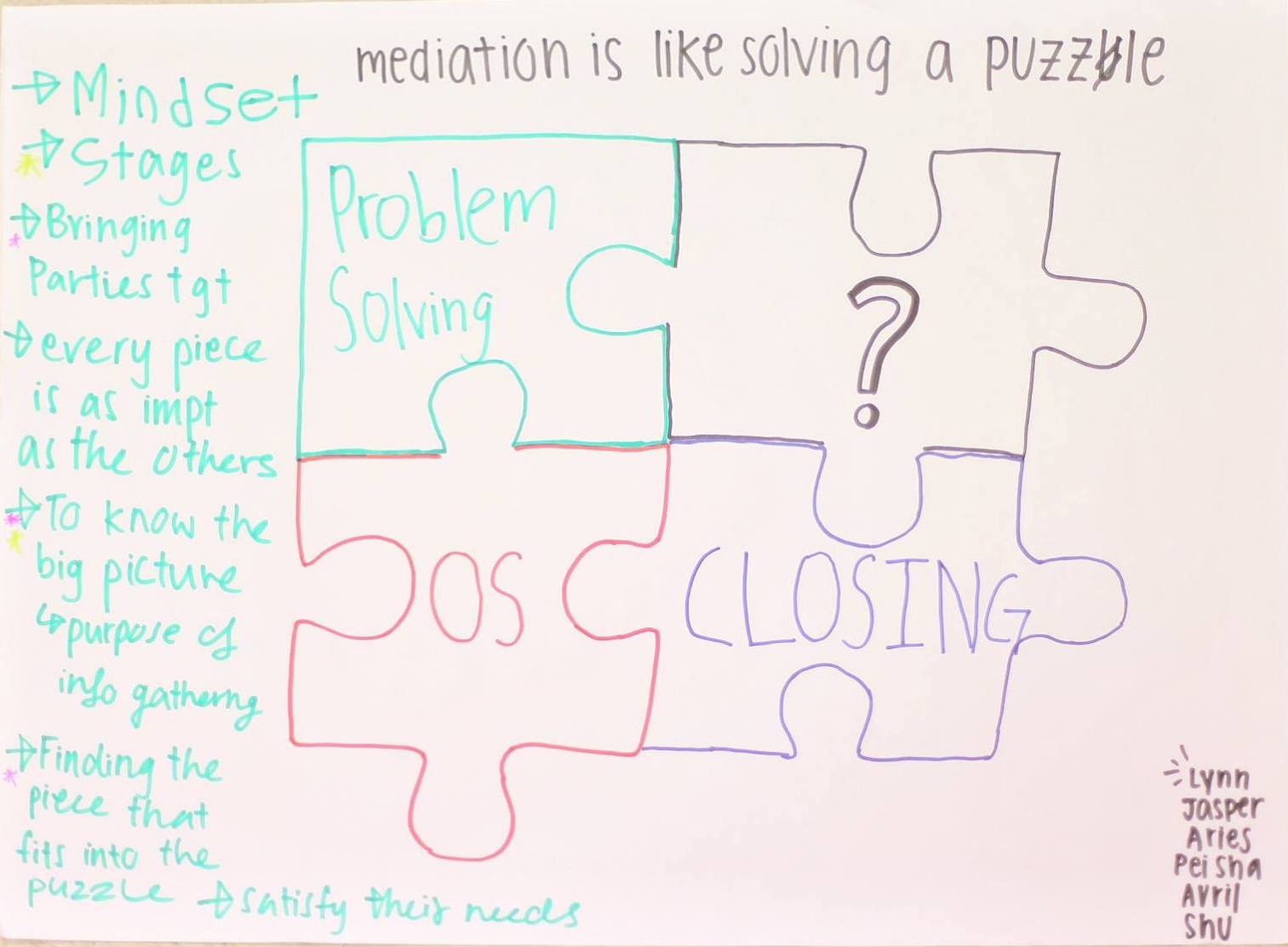
2. Mediation is like solving a puzzle

Mediation is like solving a puzzle as to solve the conflict, you need a big picture, just like referring to the picture on the box of a puzzle to solve it. Mediators need to gather and piece the different puzzles to solve the problem. Mediators find the piece that fits into the puzzle, and satisfies both parties’ needs.

Although each puzzle piece is different, they are brought together in trying to solve the puzzle. This parallels how in mediation, parties have different mindsets, but the mediator brings them together to resolve the situation.

Every puzzle piece is important, just as how all 4 steps in the process of mediation are important: without each of them, the mediation would be a failure.

The process of solving a puzzle highlights the traits a mediator should have: patience and perseverance. Like solving a puzzle, mediation may take hours or days to finish. Mediation takes quite long as parties cannot easily understand each other or find it difficult to come to a common ground. If a mediator rushes to conclude a mediation, the outcome might not be what the parties actually want. It requires persevering through a lot of trial and error. If the mediator gives up, the parties have no one left to help them resolve their conflict: the mediator is like a light for the parties.

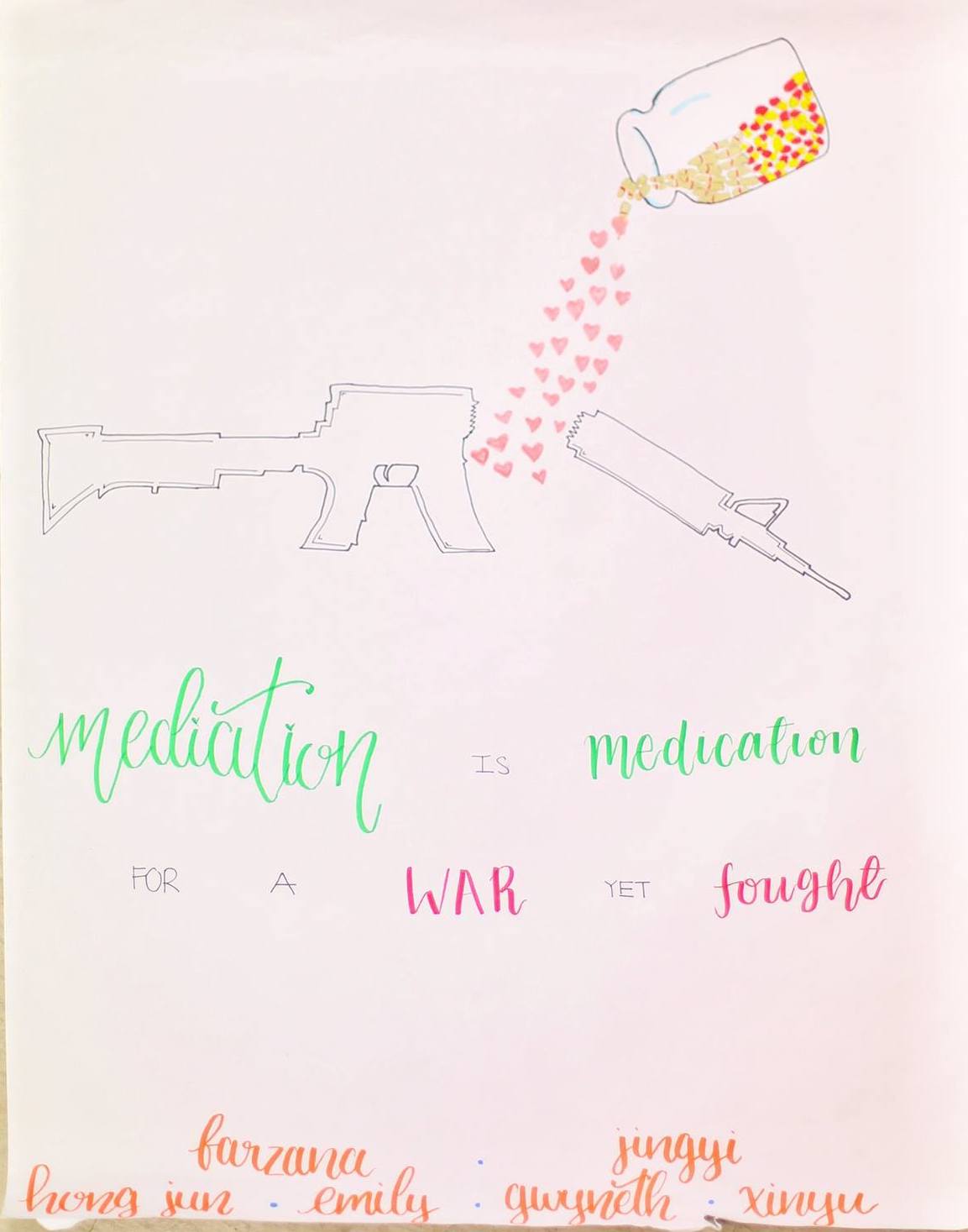
3. Mediation is medication for a war yet fought

Mediation is like medication as it mends the wound in the parties’ hearts, and allows them to better understand each other.

Medication:

  • The bottle of medication contains pills that are initially shaped as bullets. This parallels how initially, we only see the surface or the position of the parties. The words the parties say to each other in furthering their position may come out as sharp or hurtful – like bullets.
  • After mediation, the parties understand each other better, so the bullets become heart-shaped: meaning the conflict can be resolved amicably.

A War yet fought:

  • This is represented by the broken gun: which symbolizes attacks that are broken and conflicts that are being resolved.
  • This parallels how many problems can be solved with mediation before they escalate into a “war” (such as a court case).

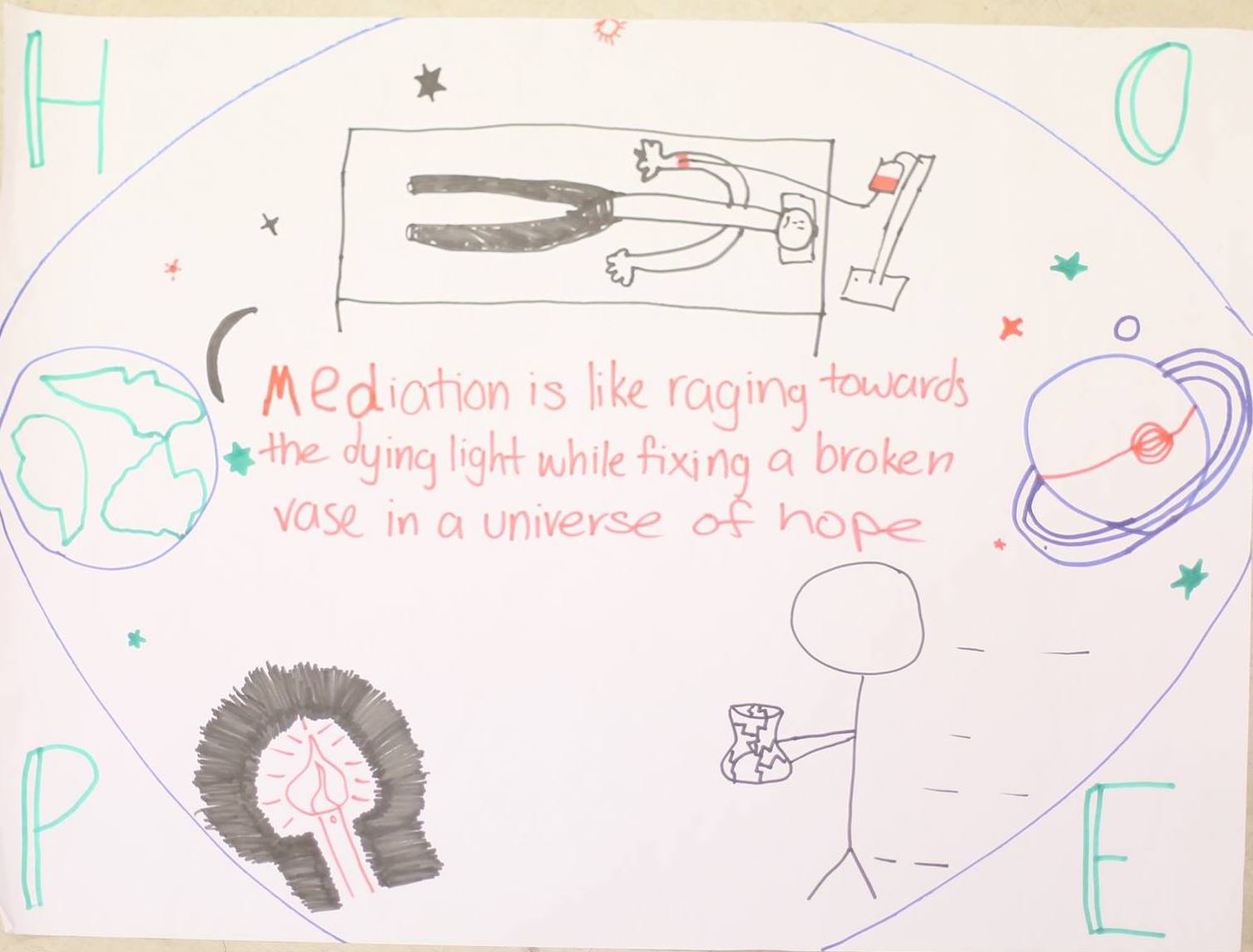
4. Mediation is like raging towards the dying light while fixing a broken vase in a universe of hope

This metaphor can be broken down into 3 parts.

  • “Mediation is like raging towards the dying light”: this is depicted by the person in bed at the top of the picture. He is about to die, and is fighting against his own fate. Raging means to fight, and this quote means to fight against the dying light. Similarly, mediation is going against their internal conflict, going against the fate of the broken relationship, and hoping against hope, to get something out of it, to patch things up within themselves.
  • “While fixing a broken vase”: the vase represents the communication and understanding between the 2 parties. While mediation fixes the broken vase, the vase will never look the same. Nonetheless, something new is still rebuilt. Even if the relationship is not as perfect as before, mediation still helps the two parties understand each other.
  • “In a universe of hope”: the whole universe is something we have never seen before, but we know exists. Mediation helps people find that hope that people want, even if we can’t see it yet.

The process of mediation is as difficult as raging, but it allows understanding between parties by facilitating communication between them.

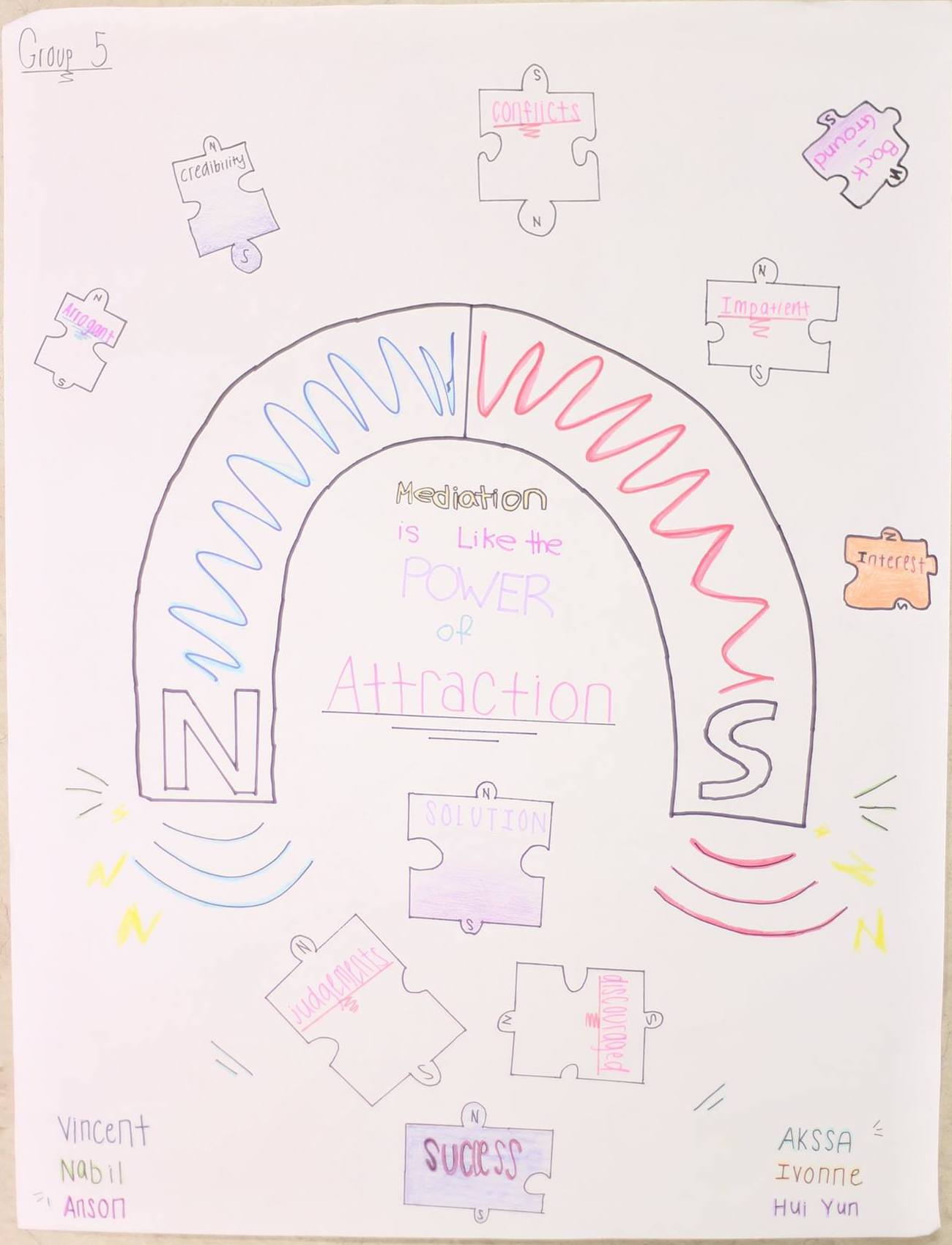
5. Mediation is like the Power of Attraction

The mediator is like a magnet, and the puzzle pieces are the elements of mediation. The mediator will ask the right questions to let the parties share their interests. The mediator will use their power to attract the right pieces for the parties to form a picture and common understanding of each other, to facilitate resolving the matter.

6. Mediation is like a Bridge

Mediation is like a bridge between two cliffs that are initially apart. Not being able to resolve a conflict hurts like a volcano and tsunami (depicted at the bottom of each cliff). This creates the sea of grief, emotions, and sorrow in between them.

Mediation lay and rebuilds a foundation between the parties with the strong sturdy bridge. It is not biased, but a platform to lead to each other, at their own pace to find their own hope and universe. It allows the parties to get out from the thunderstorm they are under and share the beautiful scene of the rainbow after the storm together, and create new beautiful memories. It’s no longer about victory or defeat, but creating a future together for both parties to enjoy.

Just as how mediation is a voluntary process, this bridge only works if both parties are willing to take a step forward, to take down their walls and build the bridge. Mediation is a bridge where parties stop talking about each other, but talk to each other. The parties are also contained in a bubble, in their own universe. This represents the confidentiality of mediation: no one knows about them – this bridge and universe is only for them, and significant to them only.

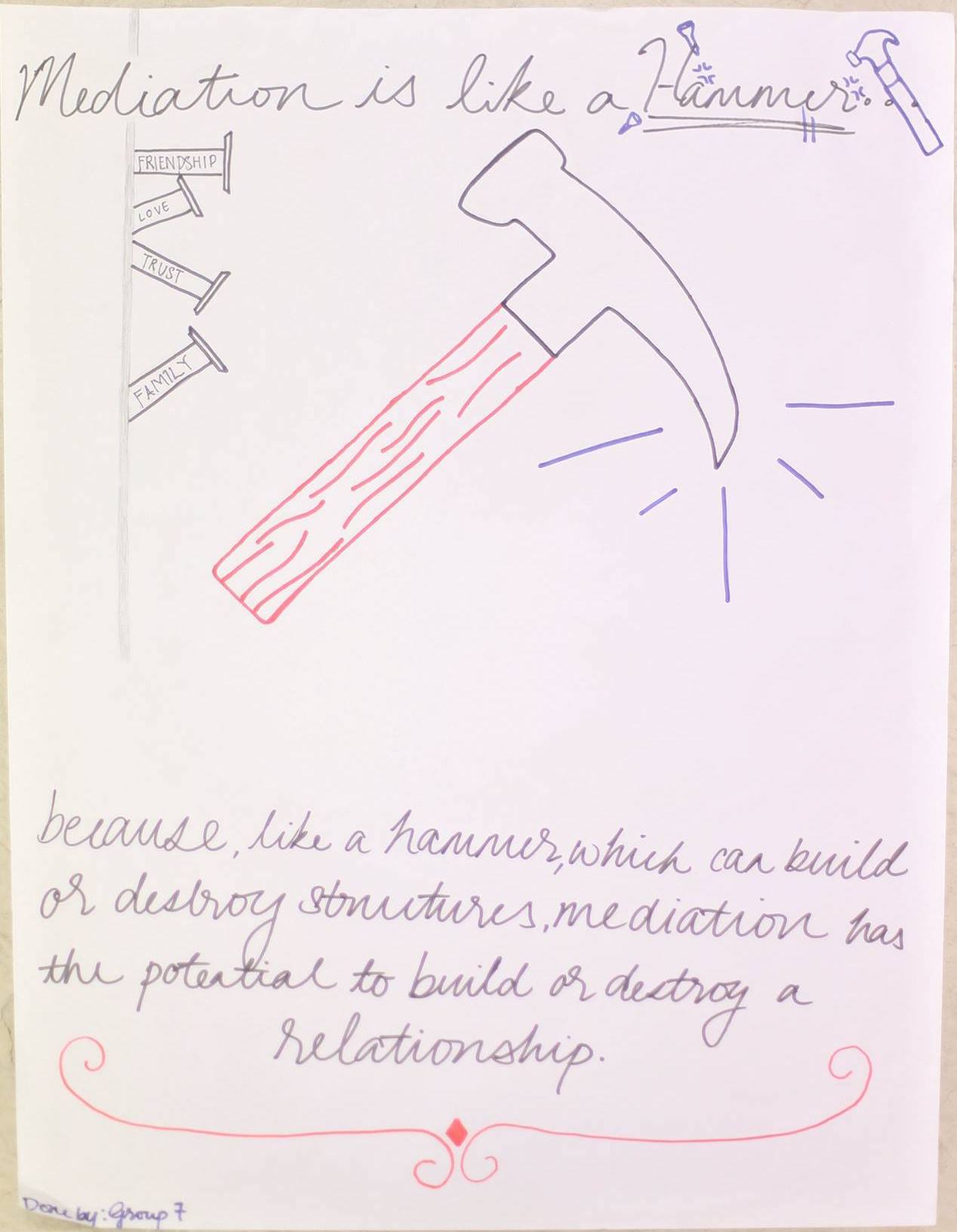
7. Mediation is like a Hammer

Like a hammer, mediation has the capacity to destroy or build structures (relationships). Nails can cause wounds, but they can also hold things in place. Thus, the nails are labelled “love”, “friendship”, “family”, “trust”. As the students wittily added: “Nails also mean if you did it [mediation] well, you NAILED it!” (sic).

8. Mediation Unlocks Hearts

Mediation unlocks hearts because when parties go through the mediation, they let down their ego and open up to each other. A hand is depicted as being wrapped around the padlock, as it is the mediator’s hand and touch that helps unlock the hearts. Although what is depicted is a single heart shape, this is because biologically speaking, the shape of a real human heart technically only comprises half a heart-shape. Thus, what is depicted is a single heart made of two human biological hearts: joined as one through mediation.

That brings us to the end of another installment of visual metaphors for mediation! I hope readers found some of these as inspiring as we did!

DSCF6197

Peace Talks - Chua Ting Fang

The Peacemakers Conference 2017 will commence in one day! For our final edition of "Peace Talks" before the Conference, Chua Ting Fang (second from left), a former facilitator, shares her thoughts:

Why did you choose to become a facilitator at the Peacemakers Conference?

I had the good fortune of being taught mediation by Joel back in NUS, and it was from him that I first heard about the Peacemakers Conference. He was seeking volunteer facilitators from students who have gone through the course, and I thought- what a great idea! To be part of a conference where mediation skills will be taught to young students, and where I can offer some perspective and learn from/alongside them as well. Naturally, I signed up immediately.

I did so because I strongly believe in mediation, and I still think that the earlier these skills are taught to young minds, the better. I think the extent to which there is conflict and confusion in this world is also the extent of opportunity for better communication. I think that all of us fall prey to assumptions and preconceptions that inform (and distort) our interpretations of the world. In learning to mediate, we become acutely aware of this as we strive to help parties uncover a common understanding of their conflict through a sort-of "facilitated conversation". To me, this is what's beautiful about mediation, so of course I thought this conference was a great idea!

How was it like being a facilitator at the Conference?

Equal parts fun and tiring. Mostly because I live on the other end of the island, and we had to reach school before the kids to prepare for the day ahead. The conference itself was a really good experience. I was humbled by how quickly the students picked up the mediation skills taught to them. It was really heartening to see how much the students improved with each round of practice and feedback. By the final round, the students mediated as though they had way more mediation experience than the few short days of the conference! I was honestly pretty impressed, given that it took us law students a full semester to learn and practise these skills under Joel and Marcus.

What advice would you give to the facilitators of Peacemakers Conference 2017?

Have a positive outlook! Facilitation is not without its challenges. You'll have to respond to different things each new day of the conference - so be observant, and be flexible! Be like water and make changes if you have to. Take time to mingle with the students and feel young in the process. Or old... I personally felt the latter. But yes, like I said, positive outlook!


13029433_840189422775033_8676372779817983041_o

Peace Talks - Jocelyn Koh

For the second segment of our interview series, "Peace Talks", we are featuring a former facilitator, Jocelyn Koh (third from left):

Why did you choose to become a facilitator at the Peacemakers Conference?

I was first roped in by Aloysius and Sean in 2015 to help organise and facilitate the Conference. I returned again in 2016 to help Sean, who needed support as he did not have sufficient facilitators to help with the Conference. However, as much as I would love to continue helping out for this year’s Conference, I am unable to make it due to work commitments.

How was it like being a facilitator at the Conference?

To be honest, it was actually pretty tiring. As a facilitator, we had to engage with the students, facilitate the conference and judge mediation rounds. That being said, it was personally a very fulfilling experience for me to be able to play a part in educating youths on conflict resolution skills (and watching them grow throughout the conference), and also learning myself from the conference speakers in the course of the various conference sessions.

What advice would you give to the facilitators of Peacemakers Conference 2017?

Go in with an open mind – you would benefit and learn from the Conference in ways you’d never expect. And most importantly, have fun!

pmc17

Peacemakers Conference 2017 - Report

By Choong Jia Shun and Charmaine Yap

From 19 to 21 June 2017, the Peacemakers Conference returned for its eighth iteration. The purpose of the Conference is to teach 13-16 year olds how to resolve conflicts amicably in a workshop cum competition format.

This year, we were delighted to be joined by participants from six secondary schools: Chua Chu Kang Secondary School, Commonwealth Secondary School, Hougang Secondary School, Jurong West Secondary School, Raffles Girls School (Secondary), and Yishun Town Secondary School.

Learning and Understanding

Over the course of 3 days, Conference participants were introduced to basic mediation skills through a mixture of theory and practical sessions.

Topics covered include: the identification of interests and option generation, identifying and managing emotions, along with the very important skills of active listening and reframing. Participants were also exposed to simplified mediation processes, similar to those adopted by professional bodies such as the Singapore Mediation Centre and the Singapore International Mediation Institute.

After participating in the engaging lessons delivered by student trainers and professors from the National University of Singapore’s Faculty of Law, the participants had to quickly put these teachings into practice in four competition rounds.

Despite being thrown into the deep end, the participants continually impressed the guest judges, who frequently praised their abilities to internalise and put into practice what was learnt within such a short span of time.

Imagination

Participants also got to showcase their artistic flair in the Mediation Project Exercise. Tasked with conceptualising a visual metaphor for mediation, this was also an opportunity for participants to reflect on what they had learnt over two full days of training sessions and competition.

Initially introduced as a light-hearted bonding activity, this segment of the conference has yielded creative and thoughtful metaphors. Past analogies include “Mediation is like a Cactus” and “Mediation is like a Kaleidoscope”.

This year saw mediation analogised to hammers, magnets, and lighthouses amongst others. This year’s crop of metaphors was also especially literary. Particularly memorable were the metaphors that “Mediation is like Raging Towards a Dying Light while Fixing a Broken Vase in a Universe of Hope” and “Mediation is Medication for a War yet Fought”.

The winning metaphor analogised mediation to a bridge which brings two parties together. In their presentation of their design, the team demonstrated their mastery of key mediation concepts of neutrality, voluntariness, confidentiality, and a focus on interests instead of rights. This poignant metaphor crystallised key lessons that we had hoped to impart over the conference.

The Finals

After four gruelling rounds of competition, Jurong West Secondary School and Yishun Town Secondary School Team 3 emerged as the top-scoring teams. The final round of competition was held at the newly-renovated moot court of the NUS Law Faculty. We were honoured to have Mr Aloysius Goh, A/Prof Lum Kit-Wye, and Ms Sabiha Shiraz join us as judges in this final round of competition.

Mediators from the finalist teams were given the challenge of mediating a dramatic and emotionally-charged school conflict. Jurong West Secondary School was represented by Nur Farzana Syakirah bte Adam and Ashwini Thennarasu, and Yishun Town Secondary School Team 3 was represented by Vincent Su Meng Hang and Elumalai Rithika.

Set in the newly-renovated moot court of the NUS Law Faculty, the finalists had the added pressure of mediating in front of an audience of all the facilitators and participants of the conference. Perhaps unsurprisingly, both teams rose to the challenge, and put up remarkable performances that belied their youth, demonstrating maturity and a solid grasp of core mediation skills. Jurong West Secondary School emerged as the champion team after a long and difficult process of deliberation, having impressed the judges with their steady performance and knack for asking the right questions.

Five participants were also recognised for demonstrating great spirit in learning and growing as mediators. They are Mubasysyir Bin Kahar (Yishun Town Secondary School), Ng Yun Fei Aries (Commonwealth Secondary), Brendan Cheong Zhen Hao (Hougang Secondary), Cheri Teo (Raffles Girls School (Secondary)), and Teo Kai Xin (Chua Chu Kang Secondary School).

Appreciation

The organisers sincerely thank Mr Terence Ten, Mr Nanda Meenachi Sundram, and Ms Rozana, teacher coordinators from Yishun Town Secondary School, for hosting the Conference for the 4th year running. We would also like to express our deepest appreciation to A/Prof Joel Lee, A/Prof Lim Lei Theng, Mr Marcus Lim, and Mrs Chia Swee Tin for their invaluable guidance and feedback, and for being on hand during the Conference itself to provide pedagogical input as well as (much needed) encouragement and moral support.

Much thanks also goes out to the long-suffering student facilitator team led by Sean for their dedication to seeing the Conference from start to end.

Finally, we are incredibly grateful for the energy and enthusiasm shown by our participants. Over the course of the conference, you asked brilliant questions, were incredibly diligent, and very capably put all that you had learnt into practice. It has been such a joy to see how everyone grow in confidence and proficiency as mediators in such a short period of time. While watching you grow and learn, we have learnt much from all of you as well.

For many of us, this is just the beginning of our journey as peacemakers. We have full confidence that the lessons learnt will be shared with our peers, and hope to see everyone continuously hone our skills and grow as mediators.

Till Peacemakers Conference 2018, peace out!

-

For more pictures and videos of the Peacemakers Conference 2017, please visit the Peacemakers Facebook Page.

As Singapore’s leading peer mediation experts, Peacemakers has an extensive track record of managing and delivering conflict resolution training for youth at both local and international levels. If you would like to train your youth to better manage conflict, let us know how we can help via email at mediate@peacemakers.sg.

DSCF6195

Peace Talks - Denise Tay

Our third segment of "Peace Talks" features our former facilitator, Denise Tay (third from left):

Why did you choose to become a facilitator at the Peacemakers Conference?

I had taken the negotiation module with Joel earlier in the academic year, and when this opportunity came around, I thought it would be interesting to see how the skills could be translated and taught to be secondary school students as well. I mostly took photographs during the conference, so that gave me the birds-eye view of what was happening during the conference.

How was it like being a facilitator at the Conference?

It was eye-opening to see the wide applicability of mediation and how it can benefit any one at all. It was also interesting to see what others thought of mediation, especially through the group presentations. One of the analogies was mediation as a cactus!

How were the students at the Conference?

They did pick up the theories and skills related to mediation very quickly, and this was probably due to their willingness to learn throughout the conference.

What advice would you give to the facilitators of Peacemakers Conference 2017?

Have a fun and enriching time! I learnt a lot about what I knew, but even more about what I didn't.

peacemakers_clear

Copyright 2026 © All Rights Reserved